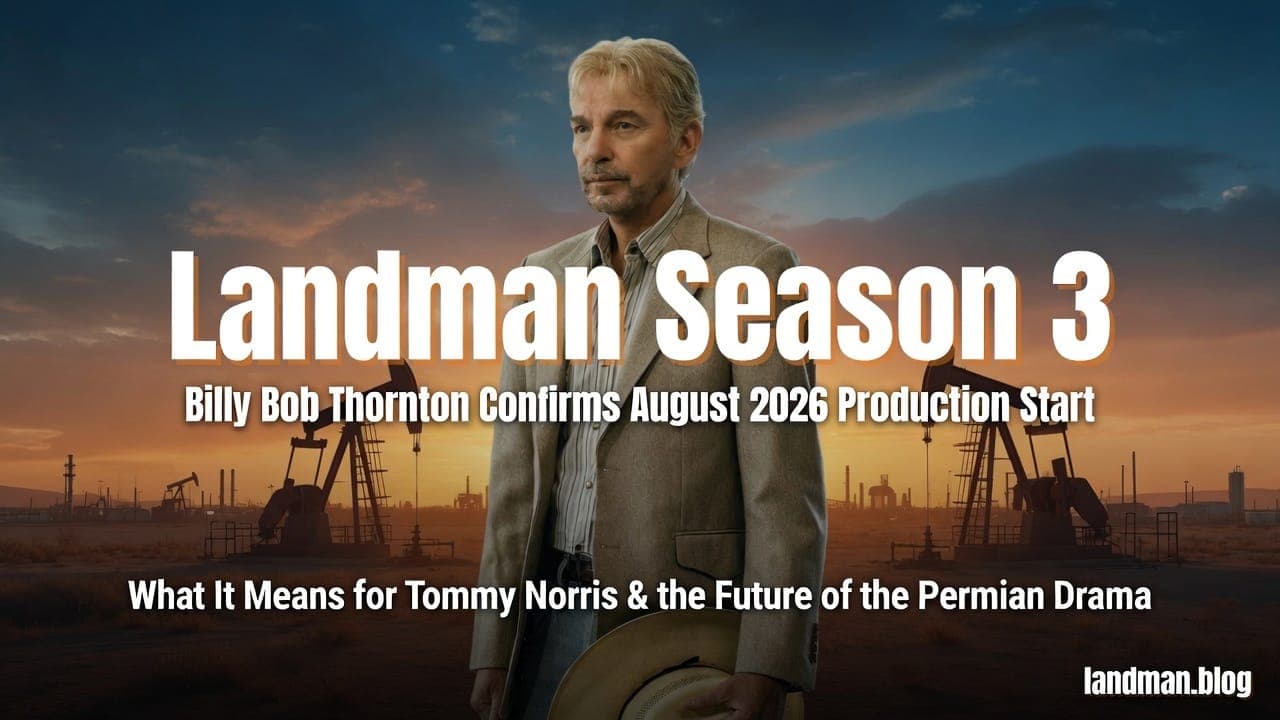
How one actor’s blunt quote (“AI-generated crap”) captures a much bigger problem: the industrialization of misinfo rmation in entertainment—and what creators, studios, journalists, and fans can do about it.
By: Jason
Date: 15 Feb 2026
The rumor that wouldn’t die
By the time Landman wrapped its second season, it had already become one of those modern streaming phenomena that seems to live in two parallel worlds.
In the first world—the one inside the show—West Texas is a pressure cooker of money, heat, danger, and moral compromise. Deals are made in dust and diesel fumes; loyalty is negotiated as much as land leases.
In the second world—the one outside the show—Landman exists as a constantly updating feed: recap threads, reaction clips, cast interviews, “ending explained” breakdowns, and endless speculation about what the next season will do.
It was in that second world that a new kind of headline popped up in early 2026: reports that Billy Bob Thornton was leaving Landman ahead of Season 3. The rumor spread quickly because it fit the internet’s favorite narrative templates: a shocking twist, a supposed behind-the-scenes conflict, the threat of a flagship show losing its centerpiece.
Then Thornton did something that has become increasingly necessary for celebrities in the AI era: he swatted the rumor down publicly and directly.
In an interview quoted by Deadline, Thornton described the stories as “AI-generated crap” and said plainly, “I’ll be there.” He also noted there were other AI-fueled claims circulating—such as a fabricated report that he and Demi Moore were now a real-life couple—adding: “They have nothing to do with reality.”
Source: Deadline (Jan 19, 2026)
https://deadline.com/2026/01/billy-bob-thornton-reports-leaving-landman-ai-crap-1236689226/
If you’re a fan, the immediate takeaway is comforting: the show’s star is not going anywhere.
But the deeper takeaway is more unsettling.
Thornton’s quote is not just a celebrity clapback. It’s a sign that entertainment gossip has entered an era where the cost of producing plausible-sounding “news” is approaching zero—and where the burden of proof increasingly shifts onto the people being lied about.
Why Landman is the perfect target for AI rumor factories
AI-generated rumors thrive in environments that have three features:
- A big audience with high emotional investment (fans who will click, share, argue, and refresh).
- A story world that invites speculation (especially after cliffhangers, cast changes, or renewals).
- Ambiguity in the production timeline (long gaps, limited official updates, and scattered quotes from interviews).
Landman checks every box.
The show is a hit; it has a built-in “Sheridanverse” audience; and Season 2 ends with a structural reset that feels like the opening move of a new game.
In The Hollywood Reporter’s finale interview, Thornton describes the ending as a blend of defiance and uneasiness, symbolized by the coyote that reappears at the end of the season. He talks about how Season 3 might combine the physical danger of Season 1 with the relationship focus of Season 2—while also emphasizing that he typically doesn’t know plot details far in advance.
Source: The Hollywood Reporter (Season 2 finale interview)
https://www.hollywoodreporter.com/tv/tv-features/landman-season-2-finale-billy-bob-thornton-interview-1236477315/
That kind of interview is catnip for speculation.
Then there’s production chatter. In early February 2026, Collider highlighted a practical constraint that becomes a narrative hook in its own right: Season 3 is expected to begin filming in May, later than prior seasons, and Texas heat will make production especially punishing because of the show’s heavy reliance on exteriors.
Source: Collider (Feb 4, 2026)
https://collider.com/landman-season-3-filming-start-may-2026-potential-release-delay/
Those details are normal. Every show has scheduling realities.
But in a media ecosystem that rewards speed over accuracy, and emotion over verification, normal details become raw material for AI rumor mills:
- “Filming starts later” becomes “production trouble.”
- “Actor signed on long-term” becomes “actor unhappy, negotiating exit.”
- “Finale resets the world” becomes “show replacing the lead.”
The result is a rumor with just enough plausibility to travel.
The new tabloid machine: from “someone said” to “something generated it”
Traditional entertainment gossip has always had loose standards, but it still had friction:
- A human writer had to write the article.
- An editor (sometimes) had to publish it.
- A site had to choose whether the potential ad revenue was worth the reputational risk.
Generative AI reduces that friction dramatically.
A single operator can produce hundreds of posts per day: “exclusive reports,” “sources say,” “insider confirms,” “contract dispute,” “secret romance,” “cancelled,” “renewed.” Most of it is cheap, derivative, and wrong—but it doesn’t need to be correct to make money. It only needs to trigger clicks.
The Reuters Institute has a name for one broad category of this phenomenon: “AI-generated slop”—low-quality AI-produced text and images that can flood the information ecosystem, often optimized for search and advertising revenue.
Source: Reuters Institute for the Study of Journalism (Oxford)
https://reutersinstitute.politics.ox.ac.uk/news/ai-generated-slop-quietly-conquering-internet-it-threat-journalism-or-problem-will-fix-itself
That article isn’t about Hollywood specifically. But its description of a polluted information environment maps cleanly onto the entertainment rumor space:
- AI slop can take the form of entire websites masquerading as news.
- It’s often built to rank in search results, not to inform.
- Errors can spread or get cited elsewhere, causing real reputational harm.
Entertainment rumors are especially vulnerable because:
- They are inherently harder to “prove” or “disprove” quickly.
- Production details are fragmented across interviews, guild listings, social media, and leaks.
- Fans are primed to interpret narrative twists as behind-the-scenes signals.
In other words, the rumor ecosystem has become a perfect playground for automated content.
Why AI rumors feel believable (even when they’re nonsense)
If a rumor is obviously absurd, it dies.
So why do so many AI-generated entertainment rumors feel believable long enough to circulate?
Part of the answer is psychological. The Scientific American article on information overload explains how limited attention and cognitive biases push people toward quick heuristics: trusting familiar sources, following social proof, and seeking confirming narratives.
Source: Scientific American
https://www.scientificamerican.com/article/information-overload-helps-fake-news-spread-and-social-media-knows-it/
In an entertainment context, those biases translate into patterns like:
- Confirmation bias: If someone already thinks a show “can’t keep its star,” they’re more likely to believe exit rumors.
- Social proof: If a rumor is trending, it feels more legitimate.
- Narrative bias: People prefer a coherent story (“he was fired on the show, so he must be fired in real life”).
AI content exploits those patterns because it can be tuned to them.
A generated rumor doesn’t need inside information; it needs the right shape:
- A familiar headline structure.
- A confident tone.
- A few verifiable details (show title, actor name, renewal status).
- A speculative leap that’s difficult to immediately falsify.
Thornton’s comment matters because he identifies the new reality: not just that the rumor is wrong, but that the mechanism of its creation may be automated, detached from any human source at all.
The collateral damage: what AI rumors cost
It’s easy to dismiss entertainment rumors as harmless. Who cares if a fake story says an actor is leaving a show?
But the costs add up, and they’re not evenly distributed.
1) Reputational harm (and the “sticky lie” problem)
Even after a rumor is debunked, it can remain searchable.
- A false headline gets indexed.
- Copies and rewrites proliferate.
- Aggregators pick it up.
- Fans repeat it as “something I heard.”
A correction rarely spreads as far as the lie.
2) Audience trust erosion
When audiences can’t tell whether an article is legitimate, they become cynical about everything:
- Real interviews get treated like PR spin.
- Real trade reporting gets treated like “just another rumor.”
- Fan communities fracture into “believers” and “debunkers.”
This is especially damaging for a show like Landman, which relies on a sense of authenticity—oilfield realism, procedural detail, and a gritty tone.
3) Increased burden on artists and press teams
In the old tabloid era, you might have ignored the rumor.
In the AI era, you often can’t—because:
- The volume is higher.
- The falsehoods are more frequent.
- Silence can be interpreted as confirmation.
Thornton’s “AI-generated crap” quote is funny, but it also signals that stars may increasingly have to spend time publicly correcting fiction.
4) Monetization incentives that reward pollution
If a rumor site earns money from ads, each click is revenue.
If AI makes it cheap to generate 1,000 rumors and only 10 go viral, that can still be profitable. The “waste” is minimal.
This is the logic of spam—applied to entertainment news.
Why Landman Season 2’s ending supercharged the rumor cycle
To understand why “Thornton leaving” traveled so fast, you have to understand what Season 2’s ending did structurally.
In THR’s finale interview, Thornton explains that the ending is intentionally uneasy: Tommy sees the coyote and chooses, for one night, to claim his present—while knowing trouble is waiting.
That’s a character metaphor.
But online, character metaphors get misread as production signals.
The show also introduces a new configuration: Tommy is launching a new company (CTT Oil Exploration & Cattle) and aligning with dangerous power (Gallino). It’s a fresh engine for Season 3.
In other words, the narrative reset invites a meta question:
If the show is changing, is the cast changing?
That’s where AI rumors slide in: they piggyback on genuine uncertainty.
And because AI can rewrite the same rumor in dozens of ways—different titles, different “insider” angles, different keywords—it can flood search results until the rumor feels “everywhere.”
So what should we do about it?
There is no single fix. But there are practical steps—some for audiences, some for journalists, and some for the industry.
For audiences: a fast verification checklist
Before sharing an entertainment “report,” ask:
- Is it coming from a real trade or a reputable outlet? (e.g., Deadline, THR, Variety, major newspapers)
- Does it link to primary evidence? (direct quote, official statement, union listing, press release)
- Does the language feel templated? (“sources say,” “reportedly,” no names, no details, recycled paragraphs)
- Can you find the same claim reported independently by at least two credible sources?
If the answer is no, treat it as unverified—no matter how “plausible” it sounds.
For journalists: treat AI-rumor denial as part of the beat
Thornton’s quote is news not because it’s spicy, but because it reveals a structural shift.
Entertainment journalists can:
- Cover the rumor mechanism, not just the rumor outcome.
- Name the incentives. Who benefits from the lie?
- Explain verification. Show readers how you confirmed the facts.
For studios and platforms: reduce the payoff
If AI rumor sites are essentially spam, the way to fight spam is to reduce its profitability:
- Ad networks can tighten policies for low-quality auto-generated content.
- Platforms can deprioritize sites that repeatedly publish fabricated entertainment news.
- Search engines can strengthen signals for original reporting.
The Reuters Institute piece suggests that platforms have historically learned to filter spam; the same logic can apply to AI slop—if the incentives align.
A coyote, a printing press, and a lesson for 2026
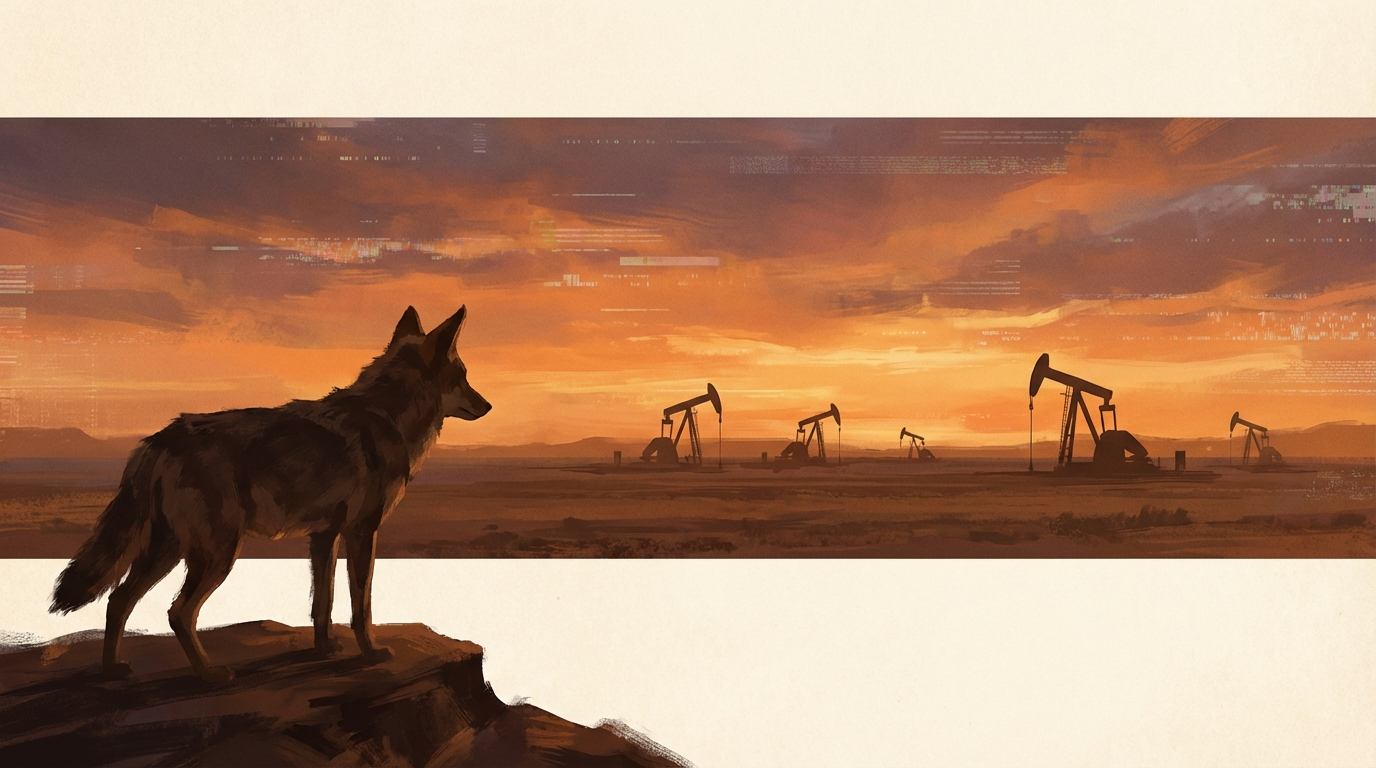
At the end of Landman Season 2, Tommy looks at the coyote and says, in effect: today is mine.
In the media world around the show, Thornton looks at the rumor mill and says: that’s AI-generated crap.
The parallel is accidental, but meaningful.
Both moments are about confronting a threat that isn’t going away:
- In the show, it’s cartel power, risk, and the cost of ambition.
- In the culture, it’s a polluted information ecosystem where fiction can be manufactured at scale.
The key is not to pretend the coyote isn’t there.
The key is to recognize it early, understand how it hunts, and stop feeding it.
Image credits
- Header illustration: AI-generated editorial illustration created for this article (AnyGen).
- Oilfield photo: Unsplash (see link below; please follow Unsplash licensing/attribution conventions).
Photo source page: https://unsplash.com/photos/silhouette-of-crane-during-sunset-cXquVXjQhJw
References (primary sources used)
- Deadline — Billy Bob Thornton Slams Reports He’s Leaving ‘Landman’ As “AI-Generated Crap” (Jan 19, 2026)
https://deadline.com/2026/01/billy-bob-thornton-reports-leaving-landman-ai-crap-1236689226/ - The Hollywood Reporter — ‘Landman’ Finale: Billy Bob Thornton… What the Final Scene Means for Season 3 and Beyond (Jan 2026)
https://www.hollywoodreporter.com/tv/tv-features/landman-season-2-finale-billy-bob-thornton-interview-1236477315/ - Collider — ‘Landman’ Season 3 Hit With Unexpected Blow Ahead of Production (Feb 4, 2026)
https://collider.com/landman-season-3-filming-start-may-2026-potential-release-delay/ - Reuters Institute (Oxford) — AI-generated slop is quietly conquering the internet…
https://reutersinstitute.politics.ox.ac.uk/news/ai-generated-slop-quietly-conquering-internet-it-threat-journalism-or-problem-will-fix-itself - Scientific American — Information Overload Helps Fake News Spread, and Social Media Knows It
https://www.scientificamerican.com/article/information-overload-helps-fake-news-spread-and-social-media-knows-it/