Gallino
Character Overview
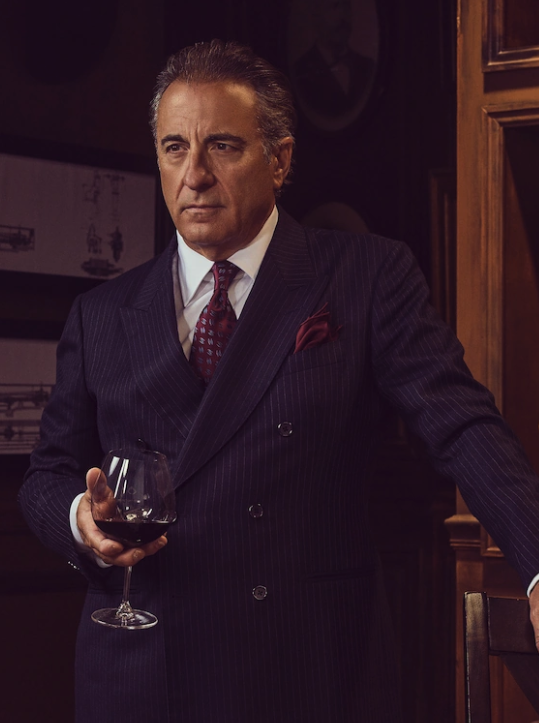
Andy Garcia's Gallino steps out of the shadows in Season 2, revealing himself as the lethal force behind the alias "Sonrisa." No longer just a distant threat, he has infiltrated the legitimate oil business by bankrolling Cooper's wildcatting dreams to launder cartel profits. With M-Tex on the brink of financial collapse, Gallino moves to acquire more than just oil rights—he aims to own the players themselves, presenting Tommy Norris with his most dangerous adversary yet.
Biography
Gallino is a high-ranking member of a Mexican drug cartel, portrayed by Academy Award-nominated actor Andy García in one of Landman's most chilling and complex performances. Gallino represents the dangerous intersection of legitimate business and organized crime in the U.S.-Mexico border region, where the massive profits from oil extraction and drug trafficking create overlapping spheres of influence that neither industry can fully escape. He becomes Tommy Norris's new cartel contact after previous members are eliminated, bringing a more sophisticated and calculating approach to the cartel's relationship with M-Tex Oil.
What makes Gallino particularly dangerous isn't overt violence or theatrical intimidation—it's his intelligence, charm, and business acumen. He presents himself as a legitimate businessman who happens to operate in an illegal industry, much like how oil executives present themselves as respectable while profiting from environmental destruction and worker exploitation. This parallel isn't accidental; Taylor Sheridan uses Gallino to ask uncomfortable questions about the moral boundaries between "legitimate" and "illegitimate" business, between legal extraction industries and criminal enterprises. When Gallino notes that "the oil doesn't care who extracts it, the money doesn't care who spends it," he's articulating a truth that characters like Tommy would prefer not to acknowledge.
Gallino's approach to business is distinctly strategic and long-term oriented. Unlike lower-level cartel members who might rely on immediate violence to achieve goals, Gallino understands that sustainable criminal enterprises require the same elements as legitimate businesses: reliable partnerships, mutually beneficial arrangements, and the ability to resolve conflicts through negotiation when possible. He prefers negotiations to violence because negotiations preserve relationships and maintain the infrastructure that makes ongoing business possible. But make no mistake—his willingness to negotiate doesn't indicate weakness or moral restraint. It indicates strategic intelligence. Gallino is comfortable with violence; he simply recognizes it as a costly tool that should be deployed selectively rather than reflexively.
The Gallino-Tommy relationship is one of Landman's most morally complex dynamics. Tommy isn't naive about who Gallino is or what he represents. Tommy knows he's dealing with a cartel leader responsible for murders, trafficking, and cartel violence that destabilizes entire regions of Mexico and the southwestern United States. Yet Tommy also operates in a reality where M-Tex Oil's operations in the Permian Basin require navigating cartel territory, where refusing to engage with criminal organizations could mean dead workers, destroyed equipment, or operations shut down through violence. Gallino offers Tommy what amounts to protection money arrangements disguised as business partnerships—pay the cartel (through various schemes involving oil operations), and M-Tex's workers and equipment remain safe.
Andy García's portrayal brings layers of sophistication to Gallino that prevent the character from becoming a stereotypical cartel villain. García, who received an Academy Award nomination for Best Supporting Actor for his role as Vincent Mancini in "The Godfather Part III" (1990), brings gravitas and nuance learned from decades of playing complex characters who exist in moral gray areas. At 68 during Season 1 filming, García plays Gallino not as a hothead or psychopath but as a mature professional who's spent decades building power and wealth through calculated risk-taking and strategic relationship management. There's a weariness in García's performance—Gallino has seen enough violence and death to know its costs, even as he's willing to authorize it when business requires.
Gallino's character also represents the geopolitical reality of the U.S.-Mexico border region. Mexican drug cartels control territory and smuggling routes that overlap with oil operations, creating inevitable intersections between these industries. Oil companies operating near the border face choices: engage with cartels to ensure operational security, or refuse engagement and risk becoming targets. Gallino embodies the cartel's side of this dynamic—he's not asking M-Tex to help smuggle drugs or commit crimes directly, but he is demanding payment (in various forms) for allowing M-Tex to operate safely in territory the cartel considers under its control. From Gallino's perspective, this is simply business: M-Tex extracts valuable resources from land the cartel effectively controls, so M-Tex should pay for that privilege.
What's particularly interesting about Gallino is how he challenges viewers' assumptions about morality in business. When he tells Tommy "your industry and mine, we're not so different," it's easy to dismiss this as criminal rationalization. But consider: both industries extract resources that harm communities (oil destroys environments, drugs destroy lives); both industries operate through violence (oil companies use state violence via police and military, cartels use direct violence); both industries create massive wealth inequality (oil executives and cartel leaders both accumulate fortunes while workers face danger and exploitation); both industries corrupt government (oil through lobbying, cartels through bribes and threats). Gallino's comparison isn't entirely wrong—it's just uncomfortable for viewers invested in believing legitimate business operates on fundamentally different moral principles than organized crime.
Gallino's appearance in Landman also adds international intrigue and raises the stakes beyond domestic oil industry drama. His presence reminds viewers that West Texas oil operations don't exist in isolation—they're part of complex geopolitical dynamics involving Mexican cartels, international energy markets, border security, and the flow of both legal and illegal goods across the U.S.-Mexico border. Gallino represents forces that neither Tommy nor M-Tex Oil can control, external pressures that constrain their choices regardless of what they might prefer to do.
The character will likely play an expanding role in Season 2, particularly as power dynamics at M-Tex shift following Monty Miller's death. Gallino has cultivated a working relationship with Tommy, but what happens when new leadership potentially changes M-Tex's approach to cartel negotiations? Will Gallino maintain patience with new executives who might be less willing to engage with criminal organizations? Or will M-Tex discover that once you've entered into arrangements with cartels, extracting yourself is far more dangerous than staying engaged? These questions position Gallino as a long-term complicating force in Landman's narrative.
Personality
Gallino's defining characteristic is his sophisticated intelligence—he's not a street-level enforcer who rose through violence, but a strategic thinker who understands that sustainable power comes from building systems, not just inspiring fear. He approaches cartel leadership the way a Fortune 500 CEO approaches corporate management: identifying opportunities, assessing risks, building partnerships, managing stakeholders, and deploying resources (including violence) strategically rather than emotionally. This business-minded approach makes him far more dangerous than thugs who rely on intimidation—Gallino is genuinely intelligent, educated, and capable of long-term strategic thinking that allows the cartel to operate as a sophisticated international organization rather than a gang.
Gallino is also remarkably charming and socially sophisticated. He can navigate high-level business meetings, engage in philosophical discussions about morality and commerce, and present himself as a cultured professional rather than a criminal. This charm isn't superficial performance—it's genuine social intelligence developed over decades of relationship management across cultures, languages, and social classes. Gallino can speak to oil executives, corrupt government officials, and street-level operators with equal fluency because he understands that successful criminal enterprises require managing relationships at every level. His charm makes him likeable, which creates cognitive dissonance for viewers (and characters like Tommy) who know intellectually that he's responsible for horrific violence yet find themselves actually enjoying his company.
Yet beneath the charm and business sophistication lies ruthless pragmatism. Gallino didn't reach his position in cartel leadership by being nice or squeamish about violence. He's authorized murders, torture, and tactics that would make most people physically ill. The difference is that Gallino views violence the way a surgeon views a scalpel: a necessary tool for specific purposes, not something to be used casually or for emotional satisfaction. When Gallino says "I prefer negotiations to violence but I'm comfortable with both," he's not bluffing or posturing—he's articulating a genuine preference while making clear he has no moral qualms about violence when business requires it. This calculated approach to brutality is more chilling than mindless aggression because it reveals someone who's made peace with authorizing terrible things as routine business decisions.
Gallino also demonstrates cultural complexity that prevents him from being a one-dimensional villain. He's Mexican operating in U.S.-Mexico border regions, navigating complex cultural dynamics, colonial histories, and economic disparities that shape cartel operations. Gallino understands that cartels exist partially because of U.S. drug demand, U.S. weapons flowing south, and economic conditions that make cartel work more lucrative than legitimate employment for many Mexicans. He's not making excuses for cartel violence, but he operates with awareness that drug trafficking is a transnational phenomenon sustained by American consumption patterns and policy choices. This awareness gives Gallino a perspective that challenges simplistic "good guys vs. bad guys" narratives.
What makes Gallino particularly effective is his patience and emotional discipline. He doesn't lose his temper, doesn't make threats he can't deliver, doesn't allow ego to override strategic thinking. When Tommy pushes back or tries to negotiate better terms, Gallino responds with calm discussion rather than intimidation. This patience is strategic: Gallino knows that long-term business relationships require allowing partners to feel they have agency and dignity, even in arrangements where power is fundamentally asymmetric. He gives Tommy just enough room to maneuver that Tommy can tell himself he's negotiating as equals, while Gallino maintains the upper hand through implicit threats that never need to be stated explicitly.
Gallino represents something important in Taylor Sheridan's moral universe: the recognition that intelligence, charm, and business acumen are morally neutral traits that can serve either legitimate or criminal enterprises. Gallino isn't evil because he's stupid or sadistic—he's dangerous precisely because he's smart, strategic, and operating with clear-eyed assessment of how power actually works in border regions where state authority is weak and economic incentives favor criminal organizations. His character asks viewers to consider uncomfortable questions about what actually separates "legitimate" business from organized crime when both rely on violence, exploitation, and corrupting influence to maintain power and profitability.
Memorable Quotes
"We're all businessmen here, Mr. Norris. Some businesses just have different... overhead costs."
"The oil doesn't care who extracts it. The money doesn't care who spends it."
"Your industry and mine, we're not so different. We both provide what people want, regardless of the law."
"I prefer negotiations to violence. But I'm comfortable with both."
"Trust is expensive in my business. But once earned, it's permanent."
Key Relationships
- Tommy Norris (business associate)
- Cooper Norris (business partner - Season 2)
Character Analysis
Gallino represents a crucial element in Taylor Sheridan's exploration of the modern American oil industry. Through Andy Garcia's nuanced performance, the character embodies the complexities and contradictions inherent in this high-stakes world.
The character's role as cartel kingpin & shadow investor provides insight into the various layers of the oil business, from the personal relationships that drive decision-making to the broader economic and environmental implications of the industry.
🎬 Behind the Scenes
- Andy García received an Academy Award nomination for Best Supporting Actor for his role as Vincent Mancini in "The Godfather Part III" (1990)
- García is 68 years old during Season 1 filming, bringing mature gravitas to the role of an experienced cartel leader
- García is Cuban-American, born in Havana and raised in Miami, bringing authentic Latino cultural depth to Gallino's portrayal
- Gallino's character represents the reality that Mexican drug cartels control territory overlapping with U.S. oil operations near the border
- The Gallino-Tommy dynamic explores uncomfortable parallels between "legitimate" business and organized crime
- Taylor Sheridan interviewed border security experts and researchers studying cartel operations to create an authentic composite character
- Gallino's business-minded approach reflects real cartel evolution toward sophisticated international organizations rather than street gangs
- The character challenges viewers to consider how U.S. drug demand and weapons flow south sustain cartel power that affects oil operations
- García's performance in "The Godfather Part III" prepared him perfectly for playing a charming yet dangerous criminal leader
- Gallino appears in 3 episodes during Season 1, with his role expected to expand in Season 2 as M-Tex leadership changes
- The character embodies the geopolitical complexity of U.S.-Mexico border regions where state authority is weak and economic incentives favor criminal organizations
- Gallino's calm, strategic approach to violence is more chilling than theatrical brutality—reflecting real cartel leaders who treat violence as routine business decisions
Series Information
Gallino appears as a recurring character throughout the series, playing a vital role in the unfolding drama of the Texas oil industry.
Frequently Asked Questions About Gallino
🎭 Who plays Gallino in Landman?
Answer: Gallino is portrayed by Andy García, the Academy Award-nominated actor known for his role as Vincent Mancini in "The Godfather Part III" (1990). At 68 during Season 1 filming, García brings mature gravitas to the role of an experienced cartel leader. García is Cuban-American, born in Havana and raised in Miami, bringing authentic Latino cultural depth to Gallino's portrayal. His legendary performance in "The Godfather Part III" prepared him perfectly for playing a charming yet dangerous criminal leader who operates at the intersection of legitimate business and organized crime. García's decades of experience playing complex characters in moral gray areas makes him ideal for embodying Gallino's sophisticated intelligence and ruthless pragmatism.
🚫 What is Gallino's role in Landman?
Answer: Gallino is a high-ranking member of a Mexican drug cartel who becomes Tommy Norris's new cartel contact after previous members are eliminated. He represents the dangerous intersection of legitimate business and organized crime in the U.S.-Mexico border region, where massive profits from oil extraction and drug trafficking create overlapping spheres of influence that neither industry can fully escape. Gallino offers Tommy what amounts to protection money arrangements disguised as business partnerships—pay the cartel through various schemes involving oil operations, and M-Tex's workers and equipment remain safe from cartel violence. His character embodies the reality that Mexican drug cartels control territory overlapping with U.S. oil operations near the border, forcing companies like M-Tex to navigate impossible choices between engagement and risk.
⚖️ Why does Gallino say his business is similar to the oil industry?
Answer: Gallino's comparison between cartels and oil companies is uncomfortable but not entirely wrong. Both industries extract resources that harm communities (oil destroys environments, drugs destroy lives); both operate through violence (oil companies use state violence via police and military, cartels use direct violence); both create massive wealth inequality where leaders accumulate fortunes while workers face danger and exploitation; both corrupt government (oil through lobbying and campaign donations, cartels through bribes and threats). When Gallino tells Tommy "your industry and mine, we're not so different," he's challenging assumptions about what actually separates "legitimate" business from organized crime when both rely on violence, exploitation, and corrupting influence to maintain power and profitability. Taylor Sheridan uses Gallino to ask uncomfortable questions about the moral boundaries between legal extraction industries and criminal enterprises.
🌎 Is Gallino based on a real person?
Answer: While Gallino isn't based on one specific individual, Taylor Sheridan interviewed border security experts and researchers studying cartel operations to create an authentic composite character. Gallino's business-minded approach reflects real cartel evolution toward sophisticated international organizations rather than street gangs. Modern cartel leaders increasingly operate like Fortune 500 CEOs: identifying opportunities, assessing risks, building partnerships, managing stakeholders, and deploying resources (including violence) strategically rather than emotionally. Gallino embodies the geopolitical complexity of U.S.-Mexico border regions where state authority is weak and economic incentives favor criminal organizations that inevitably intersect with oil operations. His character represents forces that companies like M-Tex cannot control—external pressures that constrain their choices regardless of what they might prefer to do.
💼 Why is Gallino so charming and intelligent?
Answer: Gallino's sophisticated intelligence and charm make him far more dangerous than stereotypical cartel villains who rely on theatrical violence and intimidation. He's not a street-level enforcer but a strategic thinker who understands that sustainable power comes from building systems, not just inspiring fear. His charm is genuine social intelligence developed over decades of relationship management across cultures, languages, and social classes. This creates cognitive dissonance for viewers (and characters like Tommy) who know intellectually he's responsible for horrific violence yet find themselves actually enjoying his company. Gallino's calm, strategic approach to violence is more chilling than mindless aggression—he views violence like a surgeon views a scalpel: a necessary tool for specific purposes, deployed selectively rather than emotionally. His character demonstrates that intelligence, charm, and business acumen are morally neutral traits that can serve either legitimate or criminal enterprises with equal effectiveness.
🔮 What is Gallino's role in Landman Season 3?
Answer: After appearing in both Season 1 and Season 2, Gallino's role is expected to expand dramatically in Season 3. In Season 2, Gallino bankrolled Cooper Norris's wildcatting operations under the alias "Dan Morrell" through the Sonrisa company, effectively laundering cartel money through legitimate oil wells. With Tommy now launching CTT Oil Exploration using Gallino's "70/30" deal, the cartel's financial tentacles reach deeper into Norris family operations than ever. Season 3's central tension revolves around whether Tommy can build a legitimate oil company while accepting cartel capital—and what happens when Gallino decides to collect on his investment. Andy García's return promises even more screen time as the power balance shifts from "business associate" to something far more dangerous.
Featured Videos
Official content from @paramountplus
📹 Official Gallino character videos coming soon from Paramount+
🔗 Explore Gallino's Business Relationships
Discover the dangerous connections between organized crime and the oil industry.