Sheriff Walt Joeberg
Character Overview
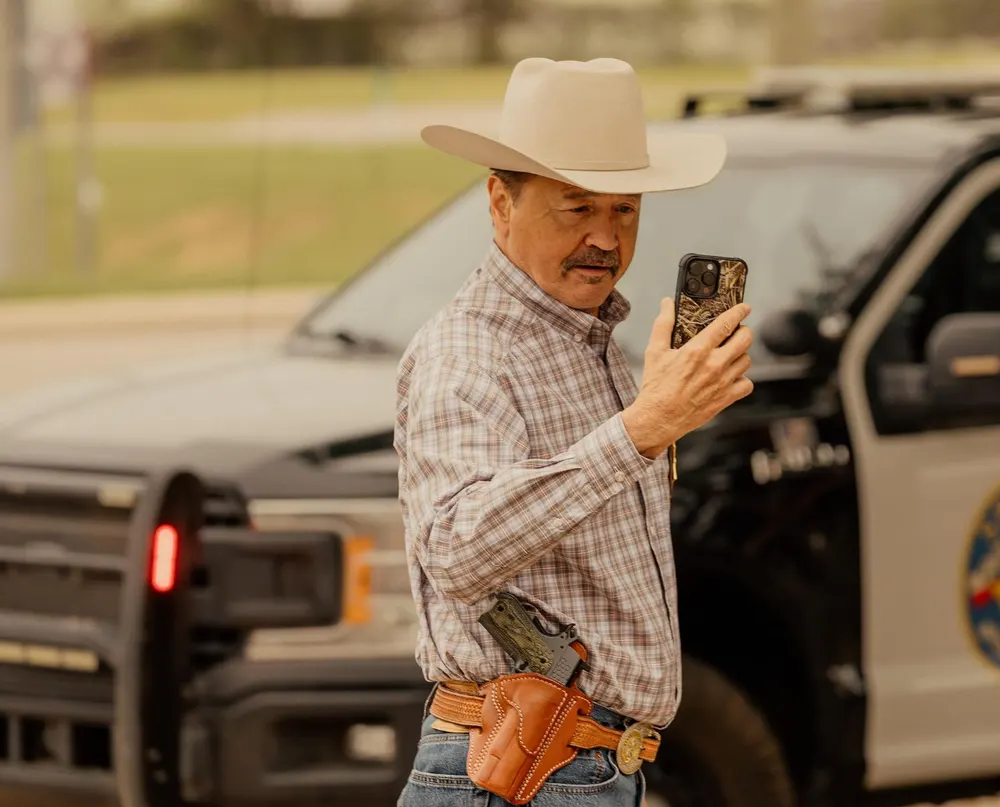
Sheriff Walt Joeberg is the law in West Texas oil country, portrayed by Mark Collie—a 90s country music star turned actor who brings authentic Texas grit to the role. As the county sheriff, Walt occupies the impossible middle ground between his community's interests and the oil industry's demands. He's Tommy Norris's most reliable ally in law enforcement, the man who shows up when planes crash, bodies are found, or situations explode—literally and figuratively. Walt represents the complex reality of rural law enforcement in resource extraction regions, where keeping the peace often means looking the other way.
Biography
Sheriff Walt Joeberg is West Texas oil country's lawman, portrayed by Mark Collie in one of Landman's most morally complex roles. Landman's explosive opening—a drug cartel's stolen plane crash-landing on M-Tex Oil's private roads, engulfing a tractor-trailer in flames—is Sheriff Joeberg's introduction to the series. He arrives on scene, surveys the carnage, and delivers the show's thesis in a single line: law enforcement will need to keep an eye on M-Tex moving forward, but they'll work together because the oil company keeps the county alive.
That moment encapsulates everything about Walt Joeberg's character: he's the sheriff of a rural Texas county where the local economy is entirely dependent on M-Tex Oil's operations, where cartel activity bleeds across the border into legitimate business, where enforcing every law would destroy the community he's sworn to protect. Walt occupies the impossible middle ground between his duty to uphold the law and the practical reality that strict enforcement would shut down M-Tex, eliminate thousands of jobs, and turn his county into an economic dead zone. So Walt makes compromises. He looks the other way when M-Tex bends regulations. He "covers Tommy's ass" when situations require creative interpretations of legality. He tries to be "accommodating" to the oil company while still maintaining enough authority to intervene when things go truly wrong.
Mark Collie's casting is perfect for this role. Collie isn't primarily an actor—he's a country music star from the 1990s who had hits like "Even the Man in the Moon Is Cryin'" and "Born to Love You." At 68 during Season 1 filming, Collie brings authentic Texas country authenticity that can't be taught in acting classes. He knows West Texas culture not from research but from lived experience. His weathered face, his laconic delivery, his comfortable command of the accent and mannerisms—it all comes from genuine familiarity with the world Sheriff Joeberg inhabits. Taylor Sheridan, known for casting musicians and real cowboys in his shows, understood that authenticity matters more than acting credentials for certain roles. Walt Joeberg needed to feel like a real West Texas sheriff, not an actor playing one. Collie delivers exactly that.
Walt's relationship with Tommy Norris forms one of Landman's most important dynamics. Tommy isn't Walt's boss—M-Tex doesn't employ the sheriff—but there's an understanding between them that borders on alliance. Walt knows Tommy is M-Tex's fixer, the guy who handles the impossible situations that keep the company operational. Tommy knows Walt is the law enforcement official who can either make M-Tex's life hell with strict regulatory enforcement or enable their operations with pragmatic accommodation. They've reached an unspoken arrangement: Tommy keeps M-Tex from doing anything so egregious that Walt can't ignore it, and Walt gives M-Tex enough operational freedom to keep the local economy running.
This isn't corruption in the traditional sense—Walt isn't taking bribes or covering up crimes for personal gain. It's something more subtle and more troubling: institutional capture. Walt's county depends on M-Tex Oil for tax revenue, employment, and economic vitality. If M-Tex shuts down or relocates, Walt's county dies. Schools close. Property values collapse. Residents leave. The county government can't function without the tax base that M-Tex provides. Walt hasn't been bribed; he's been made dependent. His choices aren't between right and wrong—they're between enforcing the law and preserving his community's survival. That's the trap that resource extraction creates in rural America: local governments become so economically dependent on extractive industries that strict legal enforcement becomes existentially threatening.
The show's opening plane crash perfectly illustrates Walt's impossible position. A drug cartel stole M-Tex's plane, crashed it on M-Tex's private roads, and created a disaster that could have killed M-Tex workers. This is clearly criminal activity requiring serious investigation. But Walt also knows that if he conducts a by-the-book investigation, he'll discover all kinds of uncomfortable truths about how M-Tex operates in cartel territory, about the informal arrangements that keep the peace, about the gray-area business practices that aren't quite legal but aren't quite crimes. A thorough investigation could expose M-Tex to liabilities that threaten their operations. So Walt investigates enough to satisfy his duty but not so much that he destabilizes the arrangement keeping his county alive. It's a tightrope walk he performs constantly.
Walt embodies the reality that rural law enforcement in resource extraction regions operates differently than law enforcement in cities or suburbs. Out in West Texas oil country, the nearest state police might be an hour away. Federal agencies are even more distant. The county sheriff is often the only law enforcement presence for hundreds of square miles. Walt doesn't have backup units, extensive resources, or specialized teams. He has himself, maybe a few deputies, and the understanding that he needs to maintain order in a region where corporate interests, cartel activity, and community needs create constant friction. His approach to law enforcement is necessarily pragmatic—he focuses on keeping people safe and preventing violence rather than strict legal compliance on every regulation.
Mark Collie plays Walt with world-weary resignation mixed with quiet authority. Walt isn't naive about the compromises he makes. He knows he's enabling M-Tex to operate in ways that push legal boundaries. He knows his "accommodation" of Tommy's crisis management sometimes means looking the other way when he shouldn't. But Walt has made a calculated decision: better to maintain working relationships with M-Tex and Tommy, better to have influence and communication channels, better to prevent the worst excesses than to enforce the law so strictly that he loses all leverage and M-Tex operates around him entirely. Walt has chosen pragmatic corruption over principled irrelevance—and the show makes it clear this isn't an easy choice or a comfortable one.
The character also represents the political economy of rural law enforcement. Walt is elected—he serves at the pleasure of voters who largely work for or depend on M-Tex Oil. If Walt started strictly enforcing environmental regulations, labor laws, or safety protocols against M-Tex, he'd probably lose the next election to someone more "business-friendly." Walt's political survival depends on maintaining the delicate balance between law enforcement legitimacy and oil industry accommodation. He can't be seen as completely captured by M-Tex (that would undermine his authority and lose public trust), but he also can't be so aggressive in regulation that he's perceived as hostile to the county's economic lifeline. This political tightrope is exhausting and morally corrosive, but it's the reality of elected law enforcement in resource-dependent communities.
Season 1 establishes Walt as the law enforcement official Tommy calls when situations need official authority but unofficial flexibility. When planes crash, when bodies are found, when industrial accidents occur, when cartel activity intersects with legitimate business—Walt is the guy who shows up, assesses the situation, and figures out how to handle it in ways that maintain order without destabilizing M-Tex's operations. His character asks uncomfortable questions about the rule of law in regions where economic survival depends on extractive industries: Can law enforcement truly be independent when the local economy depends on the industry being regulated? Is pragmatic accommodation a necessary evil or a betrayal of duty? Where's the line between community-oriented policing and institutional capture?
Personality
Sheriff Walt Joeberg is fundamentally a pragmatist who's made peace with the moral compromises required to keep his county functioning. He's not a crusading reformer trying to clean up corruption, nor is he a villain who's sold out his principles for personal gain. Walt is something more common and more complicated: a professional doing an impossible job in a system that structurally prevents doing it "correctly." His pragmatism comes not from lack of principles but from years of experience showing him that principled rigidity often produces worse outcomes than pragmatic flexibility.
Walt is deeply loyal to his community—not to M-Tex specifically, but to the people who live in his county. He knows most residents by name. He's attended their weddings and funerals. He's seen how oil industry jobs allow families to stay together, how M-Tex's tax revenue funds schools and infrastructure, how the economic ecosystem keeps his community alive in a way that strict environmental or labor law enforcement would destroy. Walt's accommodation of M-Tex isn't about loving the oil industry—it's about protecting the people whose livelihoods depend on it. Whether this justification is genuine public service or rationalization for institutional capture is a question the show explores but never fully answers.
Walt is also remarkably skilled at reading situations and people. Decades of law enforcement have taught him to assess threats quickly, to determine when situations are genuinely dangerous versus merely complicated, to judge when people are lying versus when they're telling uncomfortable truths. When Tommy calls Walt to a scene, Walt arrives with his assessment already forming—he's processing who's present, what happened, what the political implications are, how serious the legal issues might be, and how he can handle it in ways that satisfy his duty while minimizing disruption. This situational intelligence makes Walt effective at crisis management but also enables his problematic tendency to make legal judgments based on consequences rather than strict application of law.
Yet Walt is not without moral limits. He'll accommodate M-Tex's operational needs and cover for Tommy's crisis management, but he won't tolerate activities that cross certain lines. If M-Tex started trafficking drugs or explicitly partnering with cartels rather than just operating in territory where cartels are present, Walt would intervene regardless of economic consequences. If Tommy started covering up murders rather than accidents, Walt wouldn't help. Walt's pragmatism has boundaries—blurry, situation-dependent boundaries, but boundaries nonetheless. The show uses these limits to explore where accommodating law enforcement becomes corrupt law enforcement, where community-oriented flexibility becomes complicity.
Walt also carries the weight of his compromises. Mark Collie plays him with a weariness that suggests someone who's made difficult decisions for years and knows the costs. Walt isn't proud of looking the other way when M-Tex bends regulations. He doesn't celebrate his "accommodation" of oil industry excesses. He's resigned to it as the price of keeping his community alive, but resignation isn't the same as comfort. Walt knows he's compromised his role as impartial law enforcement, knows historians might judge him harshly, knows that if circumstances were different he might enforce the law differently. But circumstances aren't different, and Walt has made his choices.
What makes Walt compelling is that the show neither fully condemns nor fully endorses his approach. Taylor Sheridan presents Walt as someone trying to do his job in a broken system where perfect virtue produces terrible outcomes and pragmatic compromise produces better but still problematic results. Is Walt a good sheriff who understands that effective law enforcement requires community trust and practical accommodation? Or is he a captured official who's rationalized his failure to enforce the law by claiming it's for the community's good? The answer is probably both, which makes Sheriff Walt Joeberg one of Landman's most realistic portrayals of how institutions actually function in resource-dependent regions.
Memorable Quotes
"Anytime something blows up, or somebody finds a body, they call Walt."
"I try to be accommodating. I try to cover Tommy's ass when I have to."
"This is my county. The oil company helps keep it alive, so I help keep them operating."
"Law enforcement out here isn't black and white. It's all shades of crude."
"You want me to enforce every regulation? Fine. But then we're both out of a job."
Key Relationships
- Tommy Norris (ally)
- M-Tex Oil (regulatory oversight)
- West Texas Community (protector)
Character Analysis
Sheriff Walt Joeberg represents a crucial element in Taylor Sheridan's exploration of the modern American oil industry. Through Mark Collie's nuanced performance, the character embodies the complexities and contradictions inherent in this high-stakes world.
The character's role as west texas sheriff & community mediator provides insight into the various layers of the oil business, from the personal relationships that drive decision-making to the broader economic and environmental implications of the industry.
🎬 Behind the Scenes
- Mark Collie is primarily known as a 90s country music star with hits like "Even the Man in the Moon Is Cryin'" and "Born to Love You"
- Collie has also appeared in films including "Fire Down Below" (1997) with Steven Seagal and "The Punisher" (2004)
- At 68 during Season 1 filming, Collie brings authentic Texas country credibility that informed his portrayal of Sheriff Joeberg
- Sheriff Joeberg appears in Landman's explosive opening scene—a cartel plane crash that establishes the show's themes of oil, law, and moral compromise
- The character's line "anytime something blows up, or somebody finds a body, they call Walt" perfectly captures his role as crisis responder
- Mark Collie described Walt as "important to the family" and someone who "tries to cover Tommy's ass when he has to"
- Taylor Sheridan frequently casts country musicians and real cowboys in his shows, valuing authenticity over traditional acting credentials
- Sheriff Joeberg represents the reality that rural law enforcement in resource extraction regions operates with economic constraints urban policing doesn't face
- The character explores institutional capture—how local governments become dependent on extractive industries they're supposed to regulate
- Walt's pragmatic approach to law enforcement reflects real patterns in oil country where strict regulation could destroy local economies
- Mark Collie's music background brings cultural authenticity to the role—he understands West Texas from lived experience, not research
- The character was promoted to series regular for Season 1, indicating his importance to Landman's ongoing narrative about law, oil, and community survival
Series Information
Sheriff Walt Joeberg appears as a main character throughout the series, playing a vital role in the unfolding drama of the Texas oil industry.