Landman Realism Audit: Could the Drilling Rig Accident in Season 1 Episode 1 Happen in Real Life?
Examining the Cooper Norris Explosion Scene - How Realistic Is It to the Real West Texas Oil Field?
West Texas setting guide
How this topic fits the world of Landman
This article explains one part of the larger West Texas story behind the series. For the full map of setting, filming reality, Midland-Odessa, and the Permian Basin, start with the West Texas in Landman hub.
Open the West Texas hubIn the adrenaline-fueled premiere of Taylor Sheridan's Landman (Season 1, Episode 1), viewers are thrust into the terrifying reality of crude oil extraction when young Cooper Norris's first day on a drilling rig ends in a catastrophic surface explosion. The sequence is visceral, deafening, and unforgettable—but how realistic is the drilling rig accident in Landman when compared to the real West Texas oil patch?
As someone watching the flames engulf the screen, you might wonder: could a blowout like this actually happen today with modern safety technology? The short answer: yes, and it recently has. But the devil, as they say in the oil field, is in the technical details and the staggering statistics of the American energy engine.
The Episode 1 Scene Breakdown: Cooper’s Trial by Fire
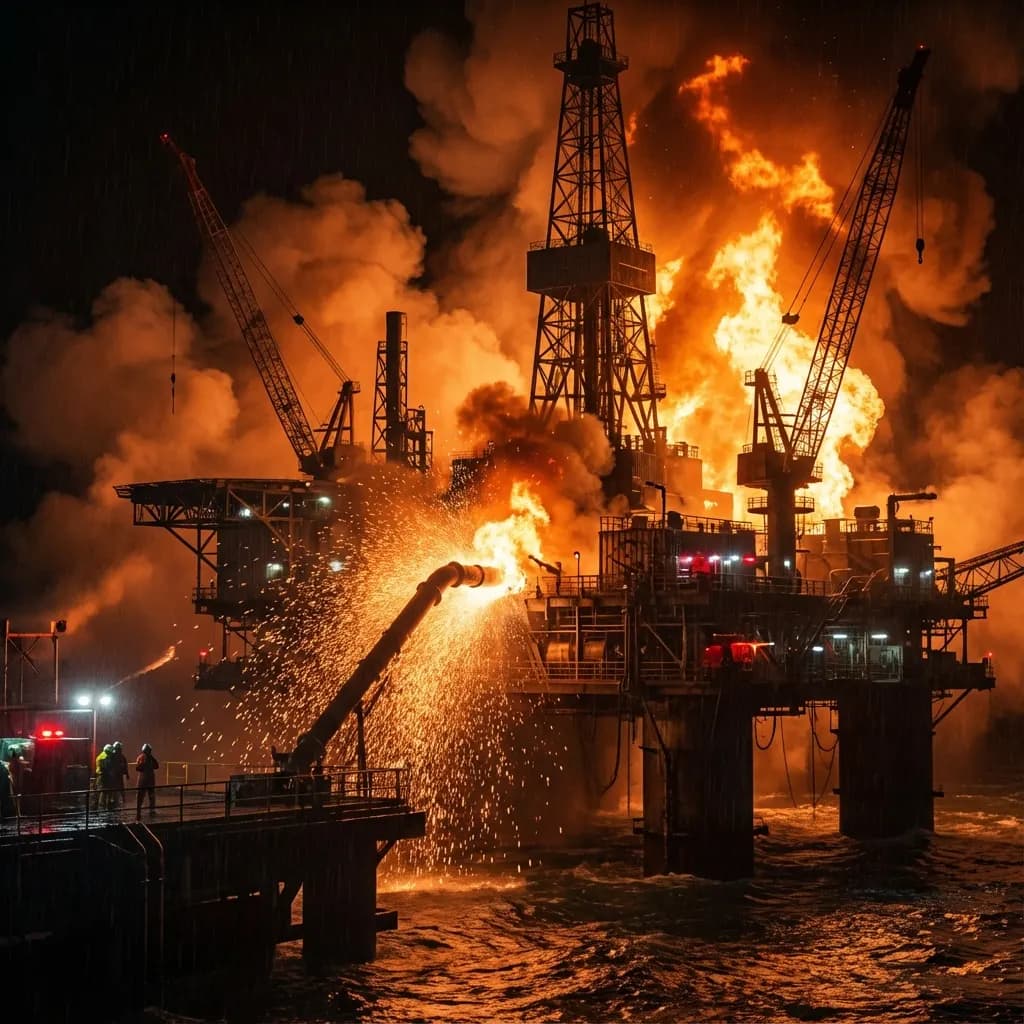
To determine how realistic the drilling rig accident in Landman actually is, we must first look at the scene itself. In the opening episode, Tommy Norris's son, Cooper, is working as a green "worm" (a novice roughneck). Tension is high on the rig floor. The crew is trying to manage subsurface pressure anomalies when a catastrophic failure occurs at the wellhead.
High-pressure gas and fluids aggressively bypass the safety mechanisms. The blowout preventer (BOP) seemingly fails, or human error exacerbates a mechanical flaw. Within seconds, a spark ignites the highly pressurized hydrocarbon mixture, resulting in a massive fireball that throws crew members across the steel decking.
⚠️ The Critical Detail: Warning Signs
Ignored Pressure Kicks
In real blowouts, the first sign of disaster is usually a "kick"—an unscheduled entry of formation fluids into the wellbore. Landman portrays the chaotic scramble that happens when a kick is not circulated out in time, a fatal error that leads directly to surface explosions.
Technical Analysis: The Mechanics of a Blowout
So, how realistic is the drilling rig accident in Landman from an engineering standpoint? To answer this, we have to look at how a modern drilling rig is supposed to control pressure.
In the Permian Basin, operators are often drilling to depths exceeding 10,000 feet, where formation pressures can routinely surpass 5,000 to 10,000 PSI (pounds per square inch). For context, a standard car tire sits at about 35 PSI.
When the drill bit hits a pocket of highly pressurized natural gas, that gas wants to expand rapidly up the wellbore. The primary defense is "drilling mud," a heavy, viscous fluid pumped down the hole to hold the pressure back via hydrostatic weight. If the mud weight is miscalculated, the secondary defense is the Blowout Preventer (BOP)—a massive stack of hydraulic valves at the surface designed to sever the drill pipe and seal the well in an emergency.
If the BOP malfunctions or is improperly maintained, the highly pressurized gas escapes to the rig floor. All it takes is a single spark from a running diesel engine, a dropped wrench, or static electricity, and you have an inferno mirroring the show.
🛢️ Industry Forum Discussion
On professional oilfield forums, veteran drillers discussing the show noted that while modern BOPs are heavily regulated, the chaotic human element shown—where inexperienced roughnecks panic under pressure—is terrifyingly accurate to historical disasters.
Real Incidents in the Permian Basin (2023-2025)
You might think explosions are a relic of the early 1900s, but recent data proves otherwise. When asking how realistic the drilling rig accident in Landman is, we only need to look at OSHA and Texas Railroad Commission reports from the past 24 months.
In January 2025, a worker named Edward Rodriguez was tragically killed and two others injured at a Permian Resources fracking site in Reeves County, Texas, when a highly pressurized device abruptly ruptured.
Just a month prior, in December 2024, Daniel Carrasco lost his life at Sendero Rig 103 in Andrews County (the heart of the Permian Basin) when a high-pressure valve violently failed.
Furthermore, in October 2024, near Toyah, Texas, an orphaned 1961 well suffered a massive blowout due to subsurface pressure, spewing a 100-foot geyser of oily, toxic water and deadly Hydrogen Sulfide (H2S) gas into the air.
These aren't isolated anomalies. Federal data reveals a grim reality for Texas oil workers.
☠️ The Grim Reality
219 Fatalities in 5 Years
A CDC study spanning 2018-2023 found 219 oilfield deaths in Texas, with the Permian Basin accounting for roughly 30% of all oilfield fatalities nationwide. Explosions accounted for over 14% of these deaths. The danger portrayed in Landman is mathematically sound.
Expert Validation: Christian Wallace's Touch
Much of why we can definitively answer "how realistic is the drilling rig accident in Landman" with a resounding "very," comes down to the show's co-creator, Christian Wallace.
Wallace is a former West Texas roughneck and the creator of the acclaimed Boomtown podcast. He didn't just read about the Permian Basin; he lived it. His technical consultation is the reason Landman gets the granular details right:
- The PPE (Personal Protective Equipment): The crew is wearing the correct FR (Fire Resistant) clothing, impact gloves, and hard hats.
- The Slang: You hear accurate usage of terms like "Company Man," "Toolpusher," and "Worms."
- The Culture of Fatigue: The show accurately depicts the grueling 12-hour shifts (or "tours") that lead to the exact type of fatigue-induced human error that causes real-world blowouts.
According to veteran petroleum engineers who evaluate media accuracy, what Landman nails isn't just the fire; it's the sequence of poor decisions, miscommunications, and equipment fatigue that precede the fire.
The Verdict: Realism Score
So, let's tally the final score on how realistic the drilling rig accident in Landman actually is.
Realism Score: 8.5 / 10
✅ What Makes It Highly Realistic
- The Cause: Pressure kicks and valve failures are the leading causes of real catastrophic blowouts, perfectly mirroring the show's setup.
- The Statistics: With explosions causing nearly 15% of Texas oilfield fatalities, the threat is statistically authentic.
- The Atmosphere: The portrayal of a chaotic rig floor where loud noise and fatigue lead to a breakdown in standard operating procedures is a known contributing factor in OSHA accident reports.
🎬 Hollywood Elements
- The Cinematic Fireball: While blowouts do cause massive fires, the specific, perfectly framed, slow-motion trajectory of the explosion is dialed up for visual drama.
- Immediate Proximity: In reality, many modern rigs have automated shut-off sensors that would evacuate personnel slightly sooner than depicted, though sudden mechanical failures can and do catch crews completely unaware.
Could this specific scenario happen in the modern Permian Basin? Absolutely, YES. If you bypass a warning sign on a high-pressure well, the physics of the Permian Basin will punish you, regardless of whether you are in a TV show or in Reeves County, Texas.
Recognizing how realistic the drilling rig accident in Landman is matters because it highlights a harsh reality: the energy that powers our modern world is extracted at a significant visceral cost. It brings awareness to the safety culture required on the rig, and the ultimate sacrifice paid by the workers who don't make it home.
Conclusion
The explosive premiere of Landman isn't just a Hollywood spectacle designed to shock viewers; it is a dramatized reflection of actual dangers lurking beneath the West Texas soil. When asked how realistic the drilling rig accident in Landman is, the combination of Christian Wallace's firsthand experience, the tragic 2024 and 2025 OSHA fatality reports, and the unforgiving high-pressure geology of the Permian Basin all point to a resounding conclusion.
That wasn't just Hollywood fantasy. That is West Texas reality.
Curious about how other Taylor Sheridan series handle realism? Check out our Taylor Sheridan universe timeline for more behind-the-scenes authenticity tracking.
Frequently Asked Questions About Rig Accidents in Landman
How realistic is the drilling rig accident in Landman compared to real life?
It is highly realistic (scoring 8.5/10). CDC data shows that explosions account for about 14% of the 219 oilfield worker deaths recorded in Texas between 2018 and 2023. The show accurately depicts the mechanical failures (like pressure kicks and valve blowouts) that cause these real-world tragedies.
What is a blowout preventer (BOP) and why didn't it work in the show?
A BOP is a massive, specialized valve installed at the wellhead designed to seal, control, and monitor oil and gas wells. In both the show and in real Chemical Safety Board accident reports, BOPs can fail due to poor maintenance, improper installation, or extreme unexpected subsurface pressure exceeding the equipment's rated limits.
Are explosions still common in the Permian Basin in 2024 and 2025?
Unfortunately, yes. As recently as January 2025, OSHA began investigating a fatal accident in Reeves County involving a ruptured pressurized device. Another incident in December 2024 in Andrews County resulted from a high-pressure valve failure. The Permian Basin remains one of the most hazardous work environments in the US.
Has co-creator Christian Wallace's experience influenced the show's accuracy?
Significantly. Christian Wallace, a former roughneck and creator of the Texas Monthly Boomtown podcast, serves as a technical consultant. His lived experience ensures that the safety gear, industry slang, and the procedural buildup to accidents shown in Landman reflect the genuine culture of West Texas rig crews.
What happens to a worker like Cooper in a real Texas oilfield accident?
In real life, roughnecks caught in blowouts face severe burn injuries or blunt force trauma from flying debris. According to Texas state data, those who survive undergo extensive rehabilitation, and the incidents trigger massive OSHA investigations, often halting rig operations for months.
How does hydrogen sulfide (H2S) make a rig blowout worse?
Many wells in the Permian Basin contain Hydrogen Sulfide (H2S), a highly toxic, flammable gas. In real blowouts, such as the October 2024 Toyah incident, the release of H2S gas can be just as deadly as the fire itself, paralyzing the respiratory system in seconds and vastly complicating rescue operations.
Sources
- Fatalities in the Oil and Gas Extraction Industry — United States, 2014–2019 - Centers for Disease Control and Prevention (CDC)
- Oil and Gas Extraction E-Tool and Fatality Reports - Occupational Safety and Health Administration (OSHA)
- Boomtown Podcast - Texas Monthly
- Texas Leads the Nation in Oil Field Deaths - Pulitzer Center
- CDC Study Finds Texas Leads Nation in Oilfield Fatalities - Houston Chronicle
- Massive Blowout Near Toyah Spews Toxic Water - DeSmog
- Burleson County Well Blowout Final Report - U.S. Chemical Safety and Hazard Investigation Board
- Texas Oil and Gas Production Data - Texas Railroad Commission (RRC)
- Worker Fatality at Sendero Rig 103 - Legal Incident Report
- Fatality at Permian Resources Fracking Site - Safety Investigation Report
- Permian Resources Reports Fatal Incident - Investing.com
- Oilfield Safety Discussions - Rigzone Forums
- Texas Oilfield Trucking Deaths - Texas Tribune
- CDC Report on Oil and Gas Worker Fatalities - Journal of Petroleum Technology
- Permian Basin Production Statistics - U.S. Energy Information Administration (EIA)
Related Blog Reading
More Landman analysis on this topic

Landman Episode 1 Recap: The Pilot Explained
⚠️ Spoiler warning. This deep-dive covers the major beats, why they matter, and how the pilot frames the show’s core tensions. What actually happens (the short version) Taylor Sheridan opens on high heat and never lifts his foot: Tommy Norris (Billy Bob Thornton), a “landman” who keeps the oil business moving on the ground, negotiates his way out of a cartel kidnapping; a truck plows into a small plane during a drug hand-off and turns into a public crisis; his home life is messy; and on his s

Landman Season 2 Episode 3 Recap: Poison Gas and M-Tex's Collapse
A Toxic Cocktail of Gas and Greed If the first two episodes of Landman Season 2 were about setting the table, Episode 3, "Almost a Home," is about flipping it over and setting it on fire. The series takes a sharp turn from high-stakes business drama to a visceral survival thriller this week, introducing an invisible killer that is far more terrifying than any cartel hitman. While Billy Bob Thornton’s Tommy Norris navigates the treacherous social politics of the Cattlemen's Club, a lethal cloud

Landman Episode 4 Recap: The Funeral Scene and What It Means
When Performance Transcends Script: A Masterclass at a Funeral The first three episodes of Landman Season 2 brought us oil rig explosions, cartel threats, and corporate power plays. But Episode 4, "Dancing Rainbows," turns the camera toward a more intimate, more painful battlefield—a fractured family's reconciliation at a funeral. This episode isn't just the season's emotional peak; it's what critics are calling "a masterclass in acting," proving what heights Taylor Sheridan's work can reach wh

Mineral Rights vs Surface Rights in Texas: The Real Conflict Behind Landman
In the vast, arid landscapes of West Texas, the land lives a double life. By day, it is the domain of the cowboy, a world of sprawling ranches, grazing cattle, and a horizon defined by tradition and heritage. By night, under the flare of drilling rigs, it transforms into the dominion of the roughneck, a high-stakes industrial zone powering the global economy. These two foundational Texas identities, the rancher and the oilman, coexist on the same sun-scorched earth, often in an uneasy, contentio
Related Episodes
See how this oil-industry topic shows up in the series.