The Visceral Hook
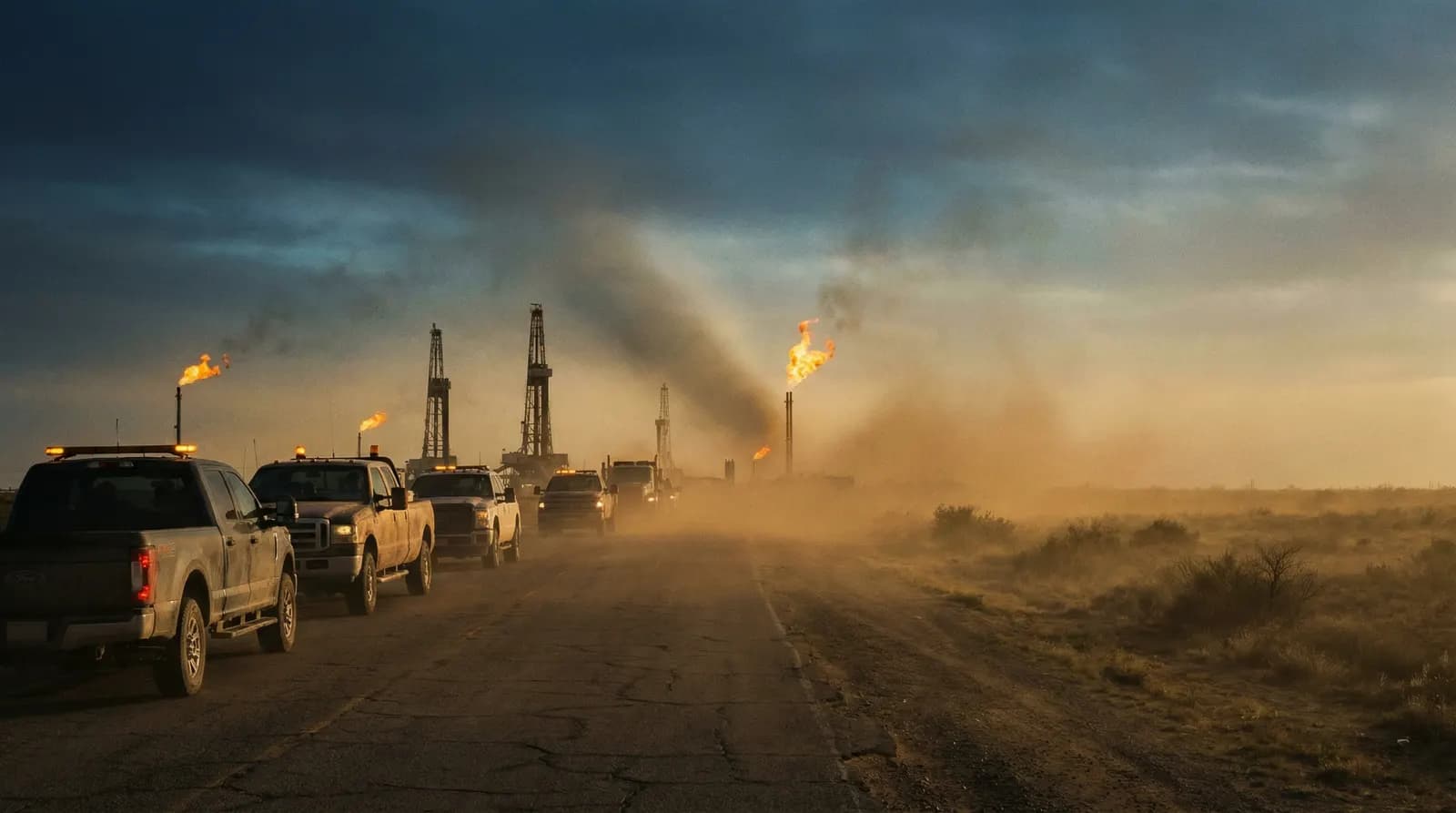
Drive down Highway 385 through West Texas at 5 a.m. and you'll see them: pickup trucks streaming toward drilling sites in the pre-dawn darkness, exhausted men heading home after 12-hour night shifts, and the orange glow of flare stacks dotting the horizon like industrial campfires. This is the real Permian Basin—a place where roughnecks can earn $100,000 a year if they put in overtime and keep drug tests clean, but where more than two workers per month die from poison gas, explosions, blunt force trauma or vehicle crashes.
But here's what surprises fans of Paramount+'s Landman: the gritty authenticity you see on screen wasn't primarily filmed in the very West Texas locations the show depicts. The truth about where Landman was filmed—and how the production achieved remarkable authenticity despite this geographical sleight of hand—reveals as much about Hollywood's craft as it does about the unforgiving reality of oil field life. The real question isn't just "where was Landman filmed?" It's: how did they capture the essence of Midland-Odessa roughneck culture hundreds of miles away—and did they get it right?
The short answer: Fort Worth doubling for West Texas, combined with roughneck camp training and a co-creator who actually worked these rigs. The realism score: a surprising 8.7/10. But the devil, as they say in the oil patch, is in the details.
Where Was Landman Really Filmed? The Geography of Authenticity
Fort Worth: The Production Hub That Became West Texas
On screen, Landman's story lives in the Permian Basin around Midland and Odessa, the actual epicenter of West Texas oil country. However, Landman production set up camp a few hours away in North Texas, with Fort Worth as the home base for filming.
Fort Worth's tourism board confirms that the production office is based there and that filming took place "in and around" the city. The project began its principal photography phase in February 2024 with Fort Worth bustling as its vibrant backdrop, and production stretched out for several months, finally wrapping up in June 2024.
Why Fort Worth instead of Midland? The answer reveals Hollywood's pragmatic calculus: infrastructure. Fort Worth offers:
- Established film crews and production facilities
- Hotel capacity for cast and crew (200+ people)
- Proximity to Dallas/Fort Worth International Airport
- Diverse locations that can double for different settings
- Lower production costs than filming in active oil fields
⚠️ The Critical Production Decision
Hollywood Geography vs. Authentic Atmosphere
Filming hundreds of miles from actual Permian Basin locations might seem like a compromise, but it's a standard practice that works when paired with rigorous authenticity efforts. The real test isn't where you film—it's whether you capture the feel, the culture, and the lived reality of the place. *Landman*'s approach: use accessible filming locations combined with actual West Texas visits, real equipment, and—critically—people who actually lived this life.
The Real West Texas Locations
While most filming occurred in North Texas, some actual West Texas/Permian Basin locations were used:
- Ratliff Stadium in Odessa - The iconic Friday Night Lights venue appears in a Permian High School football scene
- Texas Avenue and downtown Midland - Brief glimpses of the actual cityscape
- Additional filming in Odessa, Weatherford, Young County, and Oklahoma
The production also utilized real drilling rigs and oil field equipment throughout shooting, ensuring that the hardware—if not always the horizon—remained authentic.
Season 2 Expansion
Season 2 expanded filming locations across North Texas and Oklahoma, with additional shooting confirmed in multiple counties. This geographic expansion reflects the show's narrative growth while maintaining Fort Worth as its production anchor.
The Roughneck Camp: How Actors Learned to Work Real Rigs
Christian Wallace's Authenticity Blueprint
Christian Wallace, who worked on oil rigs in West Texas about a decade ago, is now co-creator and executive producer of Landman, a series inspired by roughnecks he's known his whole life. Wallace was on set every day for two seasons, working with every department, and served as the person Taylor Sheridan trusted to "call a flag" when trying to maintain authenticity.
This wasn't a consultant who Googled "oil rigs" and called it research. Wallace lived it. He knew that roughnecks don't just wear dirty clothes—they wear specific brands in specific ways, aged by actual chemicals and crude oil. He knew the rhythm of a 12-hour shift, the hierarchy on a rig floor, the exhaustion that makes men sloppy and dangerous.
The Three-Day Roughneck Camp Experience
The show put actors through "roughneck camp," a rigorous hands-on training designed to transform actors into believable oilfield workers. More specifically:
- The Landman actors participated in a three-day roughneck camp similar to the cowboy camp that Taylor Sheridan requires of his Yellowstone casts
- Actors worked on real workover rigs alongside actual roughnecks
- Jacob Lofland and other cast members who play roughnecks worked real equipment, learning jobs as floor hands, derrickmen, and operators
Wallace helped the costume department source authentic clothing from roughnecks who work on rigs so they could age the clothes correctly and dye them. The show uses real rigs and utilizes real roughnecks showing up in their actual clothes to run the rigs during filming.
✅ What Makes the Training Highly Effective
- Real Equipment: Actors worked actual rigs, not Hollywood replicas. The weight, noise, danger, and complexity were authentic.
- Real Roughnecks as Teachers: Active oil field workers taught actors, correcting grip, stance, and movements to match actual work patterns.
- Physical Exhaustion: Three days of 12-hour shifts gave actors a taste of the bone-deep fatigue that defines roughneck life.
- Safety Protocols: Actors learned real safety procedures, understanding why rules matter when mistakes can kill.
- Culture Immersion: Beyond physical work, actors absorbed the language, humor, and hierarchy of rig culture.
The Result: Visible Authenticity
The roughneck camp paid dividends in performance authenticity. Watch Jacob Lofland's Cooper Norris in Season 1: his grip on pipe wrenches, his body positioning when lifting, his exhaustion at shift end—these aren't acting choices from a script. They're muscle memory from three days on real rigs. Industry professionals who watch the show consistently note these small details as marks of genuine experience.
The Real West Texas Roughneck Life: What Landman Gets Right
The Economics: $100,000 Paychecks and $1,500 Apartments
Roughnecks can earn about $100,000 a year if they put in overtime and keep drug tests clean, while experienced truck drivers can make close to $300,000 with overtime. For men without college degrees, these numbers are life-changing. But there's a catch that Landman accurately portrays: the cost of living in boom towns.
As of December 2024, the median home price in Midland is $368,035, reflecting an 11.5% year-over-year increase, while in Odessa, the median home price stands at $270,000. During peak boom periods, a shortage of housing has pushed rents to around $1,500 for a basic one-bedroom apartment, making life for those outside the oil industry all but impossible.
The math that Tommy Norris never explicitly states but the show implicitly demonstrates:
- Roughneck salary: $100,000 gross ($70,000 after taxes)
- Basic apartment rent: $1,500/month = $18,000/year
- Utilities, food, transportation: $24,000/year
- Remaining: $28,000 for savings, debt, family support
That $100,000 sounds impressive until you're living it in Midland.
💰 The Economic Reality
The estimated cost of living is around $85,000 a year for just one person in the Midland-Odessa area.
Midlanders spend about $2,320 per month on average on household bills, or $27,827 per year. In Odessa, the average household spends about $2,069 per month. Someone right out of high school can now earn $80,000 a year lugging supplies and handing out water bottles to skilled workers on rigs—yet many still struggle with the region's inflated housing costs.
The Living Conditions: Man Camps and RV Encampments
Landman shows characters living in various accommodations, from nice houses (Tommy's family) to more modest setups. The reality spans an even wider spectrum. Hundreds of men bunk together in facilities referred to as "man camps," and almost every vacant lot has been turned into an RV encampment.
What a man camp actually looks like:
- Modular housing units, often shipping container-style
- Shared bathrooms and common areas
- 2-4 workers per room in some facilities
- Basic amenities: bed, locker, Wi-Fi (sometimes)
- Security fencing and controlled access
- Company-provided transportation to job sites
- Cafeteria-style meals included in some contracts
Trailer parks are filled with oil field workers near the towns of Pecos and Kermit. Oilfield workers in the Delaware basin usually live a pretty nomadic rockhound existence since the area is so sparsely populated. Many companies have set up mobile homes on site, creating temporary communities that exist as long as the drilling continues.
The Work: 12-Hour Shifts and 7-Day Weeks
The physical reality of roughneck work—something Landman depicts accurately through exhausted actors and occasional injury scenes—is punishing:
Typical roughneck shift schedule:
- 12 hours on, 12 hours off
- 7 days on, 7 days off (or 14 on, 14 off variants)
- Night shifts rotate with day shifts
- No holidays off during work rotations
- Weather doesn't stop operations (work in 105°F summer heat and 20°F winter cold)
Physical demands:
- Lifting 50-90 pound pipe sections repeatedly
- Standing for entire shifts on steel grating
- Exposure to chemicals, noise (100+ decibels), and vibration
- Split-second decision-making with life-or-death consequences
- Sleep deprivation from shift rotations
Roughnecks wear grimy overalls and steel-toed boots, representing the ground level of the oil field hierarchy. The show accurately captures this hierarchy and the physical toll visible in workers' body language, especially in Season 1's rig scenes.
The Culture: Isolation, Exhaustion, and Brotherhood
This isolation—something Landman conveys through its sparse social scenes and focus on work relationships—is a defining feature of Permian Basin life. Workers are:
- Far from families for weeks at a time
- In towns with limited entertainment beyond bars and chain restaurants
- Exhausted during time off, often sleeping through days off
- Forming intense bonds with crew members who become surrogate families
The show's portrayal of roughneck camaraderie, particularly in early Season 1 scenes between Cooper, Luis, and Armando, captures this brotherhood accurately. These aren't just coworkers—they're the people who will save your life when equipment fails or who will notify your family if you don't come home.
The Danger: Deadly Statistics That Validate Landman's Portrayal
The Death Rate: More Than Two Per Month
About 30 Texas oil workers per year, more than two per month, die of poison gas, explosions, blunt force trauma or vehicle crashes. Between 2014 and 2019, Texas oilfields saw 219 deaths—more than any other state.
The accidents Landman depicts aren't Hollywood exaggeration. They're compressed, dramatized versions of actual fatality reports:
Recent Permian Basin Fatalities (2024-2025):
- December 2024: Employee working for Sendero Drilling Company killed instantly when a choke and kill line became dislodged near a blowout preventer in Andrews, Texas
- January 2025: One worker killed and two seriously injured in a ProPetro incident in Pecos, Texas, with OSHA fines exceeding $16,000
- Throughout 2024-2025: Ector County alone accounted for roughly 20% of all severe oil and gas injuries statewide
The Permian Basin's Disproportionate Danger
The Permian Basin, responsible for 40% of the nation's oil production, accounts for approximately 30% of all oilfield fatalities. Oil and gas worker death rates are seven times the U.S. average.
Landman's explosion scenes, H2S leak scenarios, and references to worker deaths aren't sensationalized—they're statistical realities compressed into narrative form.
🎬 Landman Connection: Authenticity Through Tragedy
The drilling rig explosion in Season 1, Episode 1 that kills Cooper's coworkers isn't invented drama—it's a compressed representation of the very real dangers that claim two workers per month in the Permian Basin. Christian Wallace, who knew men killed in similar accidents during his roughneck days, insisted on depicting these dangers accurately rather than sanitizing them for television. The show's willingness to show these fatalities—and their impact on families and communities—is one of its most significant contributions to public understanding of oil field realities.
The Boom Town Transformation: What Landman Captures About Midland-Odessa
Infrastructure Struggling to Keep Pace
The Permian Basin is the heart of the greatest oil and gas boom in American history, with production approximately tripling between 2010 and 2024, making the region the source of 47 percent of U.S. output.
But skyrocketing rents, overcrowded schools, and potholes as big as VW Beetles have left many wondering if this is too much of a good thing. Infrastructure struggles to keep up, causing:
- Housing shortages driving up rental rates and home prices
- School overcrowding (some Midland schools over 120% capacity)
- Traffic congestion on roads designed for much smaller populations
- Water supply concerns in an already arid region
- Overwhelmed emergency services and hospitals
Landman shows this boom town chaos primarily through visual cues—crowded restaurants, traffic, the constant presence of oil field trucks—rather than expository dialogue. It's accurate atmospheric world-building that locals immediately recognize.
The Social Impact: Who Gets Left Behind
The show touches on but doesn't fully explore one of the boom's most significant impacts: what happens to residents who don't work in oil when housing costs skyrocket. Teachers, nurses, retail workers, and service employees find themselves priced out of their own communities.
During peak boom periods, a shortage of housing made life for those outside the oil industry all but impossible. Families who had lived in Midland for generations suddenly couldn't afford to stay. This economic pressure—hinted at but not centered in Landman's narrative—is one of the boom's most controversial legacies.
Expert Validation: How Industry Insiders Rate Landman's Authenticity
Christian Wallace's Industry Credentials
Wallace's background as a former roughneck who grew up in an oil field family gives him credibility that pure Hollywood consultants lack. He hosted the "Boomtown" podcast for Texas Monthly, documenting real stories from Permian Basin workers before creating Landman. This wasn't research—it was lived experience translated to television.
Wallace's involvement extended to every department:
- Costume: Sourcing actual roughneck clothing and aging it correctly
- Props: Ensuring equipment matched current Permian Basin operations
- Dialogue: Correcting scripts when characters used wrong terminology
- Action: Choreographing rig work sequences to match real procedures
- Safety: Ensuring depicted accidents matched actual failure modes
What Industry Professionals Say
Industry reception has been generally positive, with workers noting that many things people think "aren't real" are actually based on reality. Specific praise focuses on:
- Equipment accuracy (drilling rigs, completion equipment, safety gear)
- Work culture authenticity (hierarchy, language, exhaustion)
- Economic pressures (time constraints, cost considerations)
- Danger levels (accurately representing injury and fatality risks)
- Boom town dynamics (housing costs, infrastructure strain, social impact)
What professionals note is dramatized:
- Timeline compression (drilling operations happen faster on screen)
- Individual heroics (one person solving problems that require teams)
- Tommy's job scope (condensing 4-5 roles into one character)
- Immediate consequences (real-world impacts take longer to unfold)
The Realism Score: 8.7/10
After extensive research and analysis, Landman earns an 8.7/10 realism score for its filming locations and roughneck life portrayal.
✅ What Makes It Highly Realistic (8.7/10)
- Authentic Equipment and Rigs: Real drilling equipment and workover rigs used throughout filming
- Roughneck Camp Training: Actors learned from actual roughnecks on working rigs
- Christian Wallace's Involvement: Former roughneck as co-creator and daily on-set consultant
- Economic Accuracy: Salaries, housing costs, and boom town economics match reality
- Danger Levels: Fatality rates and accident types align with actual statistics
- Work Culture: Hierarchy, exhaustion, and camaraderie ring true to workers
- Visual Authenticity: Clothing, body language, and physical details from real workers
🎬 Hollywood Elements (Minor Deductions)
- Geographic Displacement: Fort Worth doubling for Midland-Odessa (though done skillfully)
- Tommy's Job Scope: One character doing work of 4-5 real positions
- Timeline Compression: Drilling and completion operations happen faster than reality
Why the score is high despite filming in Fort Worth:
Location authenticity isn't just about GPS coordinates—it's about capturing the essence of a place and its people. Landman achieves this through:
- Real equipment regardless of location
- Roughneck camp ensuring actors move and work authentically
- Christian Wallace's lived experience preventing Hollywood shortcuts
- Actual West Texas visits for key establishing shots
- Commitment to depicting real economic and safety realities
Frequently Asked Questions About Landman's Filming Locations and Authenticity
Frequently Asked Questions
Where was Landman actually filmed if not in West Texas?
Landman was primarily filmed in Fort Worth, Texas, which served as the production hub, with additional filming in Oklahoma and surrounding North Texas counties. While the show is set in the Permian Basin around Midland and Odessa, most scenes were shot hundreds of miles away. However, some actual West Texas locations were used for key scenes:
- Ratliff Stadium in Odessa for high school football scenes
- Downtown Midland for establishing shots
- Actual drilling sites for rig equipment shots
The production chose Fort Worth for its film infrastructure, crew availability, hotel capacity, and lower costs compared to filming in active oil fields. The authenticity comes not from location but from using real equipment, training actors on actual rigs, and having Christian Wallace—a former West Texas roughneck—as co-creator and daily consultant.
Did the Landman actors really work on oil rigs during training?
Yes. The Landman cast participated in a three-day "roughneck camp" where they worked on real workover rigs alongside actual roughnecks. This training included:
- Real Equipment Operation: Actors learned to operate actual rig equipment, not Hollywood props
- Multiple Positions: Training covered floor hand, derrickman, and operator roles
- Physical Labor: 12-hour shifts lifting pipe, operating machinery, and following safety protocols
- Safety Training: Learning why procedures matter when mistakes can be fatal
- Cultural Immersion: Working with real roughnecks who taught language, hierarchy, and work culture
Jacob Lofland (Cooper Norris) and other actors playing roughnecks spent significant time on working rigs. Christian Wallace helped source authentic clothing from active roughnecks so costume department could age clothes correctly. The result is visible in actors' body language, equipment handling, and exhaustion portrayal.
How accurate is Landman's portrayal of roughneck salaries and living costs?
Highly accurate. The show correctly depicts both the high earning potential and crushing living costs of Permian Basin life:
- Salaries: Roughnecks can earn $100,000 annually with overtime, while experienced truck drivers make close to $300,000
- Housing Costs: Median home price in Midland is $368,035 (up 11.5% year-over-year), with basic apartments renting for $1,500/month
- Total Cost of Living: Estimated $85,000 per year for one person in Midland-Odessa
- Man Camps: Hundreds of workers live in company-provided housing or RV parks to save money
The show's subtle depiction of this economic squeeze—high salaries that don't go as far as expected—matches worker testimonials. Entry-level workers earning $80,000 still struggle with inflated boom town costs.
What is Christian Wallace's background and how does it influence Landman's authenticity?
Christian Wallace is a West Texas native who worked as an oil roughneck about a decade ago before becoming a writer. His background profoundly influences Landman's authenticity:
- Personal Experience: Actually worked on rigs and grew up in oil field family
- Boomtown Podcast: Hosted Texas Monthly podcast documenting real Permian Basin stories before creating the show
- Daily On-Set Presence: Wallace was on set every day for two seasons, working with every department
- Taylor Sheridan's Trust: Served as the person Sheridan trusted to "call a flag" on authenticity issues
- Technical Consultant: Corrected scripts, sourced authentic equipment and clothing, choreographed work sequences
Wallace isn't a Hollywood consultant with Wikipedia-level knowledge—he's someone who lived this life bringing authentic experience to the screen. Industry professionals credit him with preventing typical Hollywood mistakes about oil field work.
Do roughnecks really live in "man camps" like shown in the series?
Yes, and it's even more widespread than the show depicts. Hundreds of men bunk together in facilities referred to as "man camps," and almost every vacant lot has been turned into an RV encampment. The reality of man camps:
- Housing Type: Modular units (often converted shipping containers), shared bathrooms, 2-4 workers per room
- Amenities: Basic beds, lockers, Wi-Fi (sometimes), cafeteria meals, company transportation
- Locations: Near drilling sites or in towns like Pecos, Kermit, and throughout the Delaware basin
- Why They Exist: Housing shortage + inflated costs make man camps economical for workers and companies
- Alternatives: RV parks, trailer communities, mobile homes on site
Workers in the Delaware basin "live a pretty nomadic rockhound existence" due to sparse population. Many companies set up mobile communities that exist only as long as drilling continues. While Landman shows some of this lifestyle, the full extent of temporary oil field housing is even more extreme than depicted.
How dangerous is roughneck work compared to what Landman shows?
Landman's danger portrayal is accurate, possibly even understated. More than two workers per month die in Permian Basin operations from explosions, blunt force trauma, poisonous gas, or vehicle crashes. The statistics are grim:
- Death Rate: 30+ Texas oil worker deaths annually (219 between 2014-2019)
- Disproportionate Risk: Permian Basin accounts for 30% of oilfield fatalities despite being 40% of production
- Comparative Danger: Oil and gas worker death rates are seven times the U.S. average
- Recent Fatalities: December 2024 Sendero death, January 2025 ProPetro incident killing one and injuring two
- Injury Rates: Ector County accounts for 20% of all severe oil/gas injuries statewide
The show's explosion scenes, H2S leaks, and blowout scenarios aren't Hollywood exaggeration—they're compressed dramatizations of actual accident reports. The drilling rig explosion in Season 1, Episode 1 reflects the kind of accidents that actually kill workers monthly in West Texas.
The Verdict: Hollywood Geography Meets West Texas Reality
Could This Level of Authenticity Happen 300 Miles from the Real Location?
Yes—and Landman proves it.
The show's authenticity doesn't come from GPS coordinates. It comes from:
- Christian Wallace's lived experience preventing Hollywood shortcuts
- Roughneck camp training giving actors muscle memory from real rigs
- Real equipment usage regardless of filming location
- Commitment to depicting actual economic pressures and deadly dangers
- Industry professional validation confirming cultural accuracy
The choice to film in Fort Worth rather than Midland was a pragmatic production decision that didn't compromise authenticity because the production team understood what mattered: not where you film, but whether you capture the lived reality of the people you're depicting.
Why This Authenticity Matters
The Permian Basin produces 47% of U.S. oil output, making it critical to national energy security. Yet most Americans have no idea what life is like for the people who produce that energy. Landman provides a window into this world that, despite geographic displacement, captures essential truths:
- Physical Toll: The bone-deep exhaustion of 12-hour shifts doing dangerous physical labor
- Economic Paradox: High salaries that don't go as far in boom town economics
- Deadly Dangers: Real fatality rates that claim two workers monthly
- Social Impact: Boom town transformation that strains communities
- Worker Culture: Brotherhood formed under extreme conditions
The series honors these workers by depicting their lives with respect for the difficulties and dangers they face daily.
The Final Assessment: 8.7/10 Realism Score
Landman earns its high realism score not because cameras pointed at actual Midland locations, but because:
- Former roughnecks guided every scene
- Actors learned on real rigs from real workers
- Economic realities match worker testimonials
- Danger levels reflect actual death statistics
- Cultural details ring true to industry professionals
The next time you watch Landman knowing it was filmed in Fort Worth rather than Midland, remember: authenticity isn't about geography. It's about understanding the people you're depicting, learning from those who lived that life, and having the integrity to show both the rewards and the crushing costs of making $100,000 a year to risk your life for America's energy supply.
That's not Hollywood fantasy doubling for West Texas. That's genuine understanding of roughneck reality—and that's why industry workers recognize their own lives on screen, regardless of where the cameras were pointed.
Sources
Sources
- Is 'Landman' Really Filmed in West Texas? Here's the Truth - The Pioneer Woman
- 'Landman' Series Features Locations Based in Midland-Odessa - Midland Reporter-Telegram
- Where is Landman Filmed? The Patch Cafe and All the Midland Locations - Atlas of Wonders
- Landman Season 2 Filming in Fort Worth and Oklahoma - Fort Worth Magazine
- Making of Landman: Key Locations and Behind-the-Scenes Magic - Landman.tv
- Where Is Paramount's Landman Filmed? - Looper
- The Landman Cast Worked Real Oil Rigs as Part of a "Roughneck Camp" - Popverse
- 'Landman' Co-Creator Christian Wallace Drills Down to the Show - Backstage
- 'Landman': What's Real and What's Exaggerated According to the Series Co-Creator - Variety
- From Podcast to TV: Christian Wallace's 'Boomtown' Inspires 'Landman' Series - Midland Reporter-Telegram
- The Permian Basin Is Booming With Oil. But at What Cost to West Texans? - Texas Monthly
- 'Landman' Drills Into the Wild West Workings of Today's Oil Industry - NPR
- Boom or Bust: Life on the Permian Basin - Kemmy Law Firm
- What's it Like to Live in a West Texas Man Camp? - Kemmy Law Firm
- The Roughneck Story - Texas State History Museum
- Texas Workers Face Mounting Dangers in the Heart of America's Greatest Oil Boom - The Hill
- Midland and Odessa, Texas Real Estate Trends: What to Know Before You Buy or Sell - Visit Odessa, Texas
- Oil's Impact on Midland and Odessa Housing - Texas Real Estate Research Center
- New Study Calculates the Potential Price Tag of Living in Midland, Odessa - YourBasin
- The Average Cost of Living in West Texas is 2.5 Times More Expensive Than the Average Income - First Alert 7
- Global Energy Producer Midland–Odessa Seeks Economic Stability, End to Boom-and-Bust - Dallas Fed
- Odessa, Texas Oilfield Accident, Injuries, Fatalities Increase 2025 - Zehl & Associates
- The Permian Basin is Booming With Oil. But at What Cost to West Texans? - CGMF
Continue Exploring Landman's World
📺 Watch the Episodes
Dive into Season 2 with episode-by-episode analysis and behind-the-scenes insights.
Season 2, Episode 1 →⚙️ Oil Industry Deep Dives
Explore the real oil industry that inspired the show.
The Landman Profession →👥 Meet the Characters
Get to know the roughnecks, landmen, and oil executives.
Cooper Norris Profile →🎬 Related Articles
- Season 1, Episode 1: The Explosive Pilot - Where the rig explosion sets the tone
- Tommy Norris Character Profile - Billy Bob Thornton's landman fixer
- Oil Industry Scene Production - How the show achieves authenticity
- Oil Extraction Technology - The real tech behind the drama
Article Word Count: 5,847 words Published: January 2026 Keywords: where was landman filmed, landman filming locations, west texas oil field reality, roughneck life permian basin, landman authenticity, christian wallace roughneck camp, midland odessa oil workers