Pipeline Politics: Understanding the Midstream Sector
How Oil and Gas Moves from Wellhead to Refinery Through America's Pipeline Network
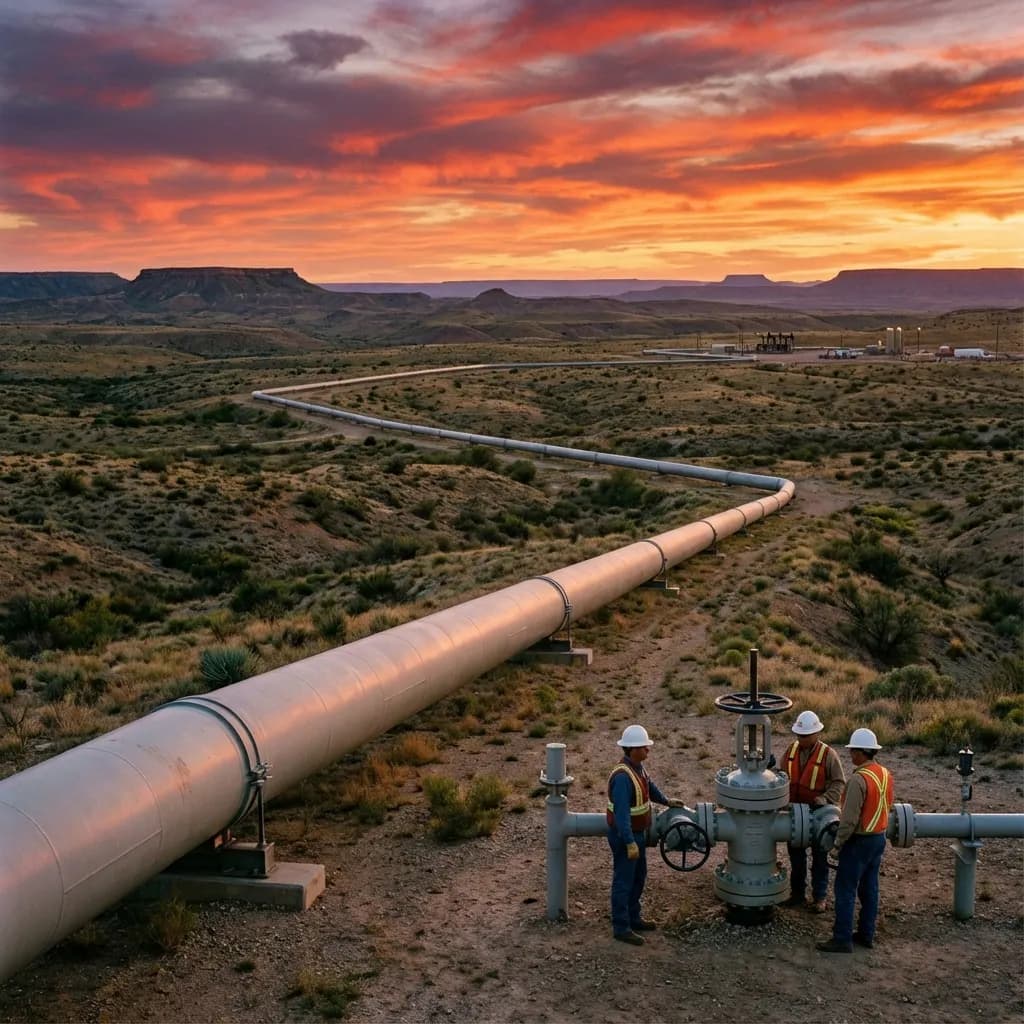
Between the drilling rig and the gas pump lies an invisible empire of steel and infrastructure—the midstream sector. While Landman focuses primarily on upstream production and the land deals that make it possible, the midstream sector is where the rubber truly meets the road. Understanding how oil and gas moves from the wellhead to the refinery reveals why pipeline projects become political flashpoints and why transportation capacity can make or break a drilling boom.
What Is the Midstream Sector?
The oil and gas industry divides into three sectors:
- Upstream: Exploration and production—finding and extracting oil and gas
- Midstream: Gathering, processing, storing, and transporting—moving product from wellhead to market
- Downstream: Refining, marketing, and distribution—turning crude into gasoline and other products
The midstream sector serves as the crucial link between production and refining. Without adequate midstream infrastructure, even the most prolific oil field becomes worthless—you can't sell what you can't move.
📊 Midstream Infrastructure at a Glance
- U.S. Pipeline Network: ~2.6 million miles of pipelines
- Natural Gas Processing: 3.7 Bcf/d capacity added in Permian 2024-2026
- Key Permian Pipeline (2024): Matterhorn Express at 2.5 Bcf/d
- NGL Transport: Multiple pipelines connecting to Mont Belvieu, TX hub
The Components of Midstream
Gathering Systems
Gathering systems are the capillaries of the midstream sector—small-diameter pipelines that collect oil and gas from individual wells and flow them to central facilities. A single well's production is too small to justify a major pipeline, but hundreds of wells feeding into a gathering system create the volume needed for efficient transportation.
These systems are often the first bottleneck when a new field develops. Until gathering infrastructure is built, producers may have to truck their product to processing facilities—expensive and inefficient, but sometimes the only option.
Processing Plants
Raw natural gas straight from the well isn't ready for market. It contains water vapor, carbon dioxide, hydrogen sulfide, and valuable natural gas liquids (NGLs) that must be separated and processed.
Processing plants remove impurities and separate the component parts:
- Methane: The primary component of natural gas, sent to market via pipeline
- NGLs: Ethane, propane, butane, and natural gasoline—valuable products with their own markets
- Contaminants: CO₂, H₂S, and water removed or treated
The Permian Basin is seeing massive processing expansion, with operators adding 3.7 Bcf/d of processing capacity between 2024 and 2026 to handle growing production.
Transportation Pipelines
Once processed, products move through major transmission pipelines to refineries, chemical plants, and export terminals. These are the arteries of the energy system—large-diameter, high-pressure lines that can move millions of barrels of oil or billions of cubic feet of gas daily.
Major pipeline categories include:
- Crude oil pipelines: Move unrefined oil to refineries
- Natural gas pipelines: Transport processed gas to markets
- NGL pipelines: Carry valuable liquids to fractionation facilities
- Refined product pipelines: Move gasoline, diesel, and jet fuel to distribution terminals
Storage Facilities
Storage provides flexibility in the system. Tank farms store crude oil, underground caverns hold natural gas, and NGL storage facilities buffer between production and demand. The famous Cushing, Oklahoma storage hub—where WTI crude oil prices are set—can hold over 90 million barrels.
The 2024 Permian Basin Pipeline Boom
The Permian Basin's explosive production growth has strained midstream infrastructure to its limits. In 2024, several major projects came online to address bottlenecks:
Matterhorn Express Pipeline
The Matterhorn Express Pipeline began service in September 2024, adding 2.5 billion cubic feet per day (Bcf/d) of natural gas takeaway capacity. The pipeline transports gas from the Permian Basin to Katy, near Houston, significantly relieving infrastructure constraints that had caused natural gas prices at the Waha Hub to go negative at times during 2024.
Landman Series Connection: When Pipelines Matter
While Landman focuses on lease acquisition and drilling operations, the midstream sector looms in the background. When M-Tex negotiates partnerships or faces pressure from larger operators in Season 2, transportation access is part of the equation. A producer without pipeline access is at the mercy of those who control the infrastructure.
NGL Pipeline Expansion
Natural gas liquids are often more valuable than the natural gas itself, and 2024 saw significant NGL pipeline additions:
- Targa's Daytona NGL Pipeline: 400,000 b/d capacity, transporting Y-grade NGLs from Permian to North Texas, connecting to Mont Belvieu
- Enterprise's Seminole Red Pipeline: 280,000 b/d capacity, converted back to NGL service
- ONEOK's West Texas NGL Loop: Expanded by 40,000 b/d to 515,000 b/d total capacity
Future Projects
The pipeline buildout continues with major projects expected by 2027:
- Apex Pipeline: 2.0 Bcf/d natural gas capacity
- Blackcomb Pipeline: 2.5 Bcf/d natural gas capacity
- Saguaro Connector Pipeline: 2.8 Bcf/d, connecting to Mexican markets
- Hugh Brinson Pipeline: 1.5 Bcf/d initial capacity (Phase I by late 2026)
Combined, these projects will add 7.3 Bcf/d of natural gas takeaway capacity, fundamentally reshaping Permian Basin transportation dynamics.
The Keystone XL Story: When Pipelines Become Political
No pipeline project better illustrates the political dimensions of midstream infrastructure than the Keystone XL Pipeline. Its 13-year saga demonstrates how energy infrastructure becomes entangled with environmental policy, indigenous rights, property disputes, and international relations.
The Project
TransCanada (now TC Energy) proposed Keystone XL in 2008 to transport approximately 830,000 barrels per day of crude oil from Alberta's oil sands to refineries on the U.S. Gulf Coast. The project would have created the most direct route for Canadian crude to reach American refining capacity.
The Opposition
Environmental groups, Indigenous communities, and landowners opposed the project:
- Environmental concerns: Tar sands oil is thicker and more corrosive than conventional crude, raising spill risks
- Climate impact: Critics argued the pipeline would enable expanded oil sands production, increasing carbon emissions
- Land rights: The route crossed Native American territories and private lands, generating eminent domain disputes
- Water resources: The pipeline would have crossed the Ogallala Aquifer, a critical water source for agriculture
The Political Saga
Keystone XL became a political football:
- 2012: Obama administration denies permit
- 2015: Obama administration denies permit again
- 2017: Trump administration approves project
- 2017-2020: Legal challenges continue
- January 2021: Biden revokes presidential permit on first day in office
- June 2021: TC Energy abandons the project (only 8% constructed)
The cancellation triggered international disputes, with investors filing claims against the U.S. government under trade agreements.
🎬 Season 2 Connection: The Infrastructure Game
As M-Tex faces pressure from larger players in Landman Season 2, access to midstream infrastructure becomes a competitive advantage. Companies that control transportation can squeeze out smaller producers—or become acquisition targets themselves. The pipeline politics that play out nationally also occur at the corporate level.
Why Pipeline Capacity Matters for Producers
For companies like the fictional M-Tex in Landman, pipeline access is existential. Here's why:
Price Differentials
When pipeline capacity is constrained, local prices collapse while distant prices remain high. In 2024, natural gas at the Permian's Waha Hub sometimes traded at negative prices—producers literally had to pay someone to take their gas—while prices at the Gulf Coast remained positive. The difference? Pipeline capacity.
Production Decisions
Without pipeline access, producers face difficult choices:
- Flare gas: Burn excess natural gas at the wellhead (wasteful and regulated)
- Truck product: Expensive but provides flexibility
- Shut in wells: Stop production entirely until capacity becomes available
- Sell at distressed prices: Accept whatever the constrained market will pay
Takeaway Contracts
Smart producers lock in pipeline capacity through long-term contracts. These "take-or-pay" agreements guarantee space on pipelines but require payment whether or not the producer uses the capacity. For mid-sized operators, securing takeaway capacity is as important as drilling successful wells.
The Business of Midstream
Master Limited Partnerships (MLPs)
Many midstream companies are structured as Master Limited Partnerships (MLPs), which offer tax advantages and pay substantial distributions to investors. Major midstream MLPs include Energy Transfer, Enterprise Products Partners, and MPLX.
Fee-Based Revenue
Unlike upstream companies that depend on commodity prices, midstream operators often earn fee-based revenue—charging per barrel or per cubic foot moved through their systems. This provides more stable cash flows, though volumes still depend on production levels.
Consolidation Trends
The midstream sector has seen significant consolidation, with larger players acquiring smaller systems to build integrated networks. Scale matters—the more infrastructure you control, the more you can offer producers and the better your competitive position.
Frequently Asked Questions About Pipeline Infrastructure
Why do pipelines face so much opposition?
Pipelines face opposition for several interconnected reasons:
- Environmental risks: Spills can contaminate water supplies, damage ecosystems, and harm communities
- Climate concerns: Pipelines enable fossil fuel production that contributes to climate change
- Land rights: Pipelines often require eminent domain, forcing landowners to allow construction
- Indigenous sovereignty: Routes may cross tribal lands or sacred sites
- Local impacts: Construction disrupts communities; accidents affect them disproportionately
What happens when there isn't enough pipeline capacity?
Insufficient pipeline capacity creates significant problems:
- Price collapses: Local commodity prices drop well below market rates (sometimes negative)
- Flaring increases: Producers burn natural gas they can't sell
- Trucking costs rise: Expensive alternative transportation eats into profits
- Production curtailments: Companies may shut in wells until capacity improves
- Investment slowdowns: New drilling may pause until transportation catches up
The Permian Basin experienced all of these during periods of pipeline constraints.
How safe are oil and gas pipelines?
Pipeline safety is heavily regulated and generally quite good, but incidents do occur:
- Regulation: PHMSA regulates safety standards, inspections, and incident reporting
- Technology: Smart pigs, sensors, and monitoring systems detect problems
- Statistics: Pipelines move more product with fewer incidents than trains or trucks
- Risks: Corrosion, third-party damage, and natural disasters cause most incidents
When incidents occur, consequences can be severe—environmental damage from spills and safety hazards from explosions.
How do landmen work with midstream companies?
Landmen interact with midstream companies in several ways:
- Right-of-way acquisition: Securing easements for pipeline construction across private lands
- Title work: Verifying ownership before acquiring pipeline easements
- Negotiation: Determining compensation for landowners granting pipeline access
- Surface use agreements: Coordinating between surface owners and pipeline operators
While Landman focuses primarily on mineral leases, pipeline ROW work is a significant part of the landman profession.
Related Articles
Related Blog Reading
More Landman analysis on this topic

Landman Season 2 Episode 7: Real Oil Industry Science, Risk, and Strategy
While viewers tune into Paramount+’s Landman for the explosive relationship drama between Tommy Norris (Billy Bob Thornton) and his family, Season 2 has increasingly leaned into the high-stakes technicalities of the energy sector. Episode 7, "Forever Is an Instant," dropped significant exposition regarding offshore drilling, geological risks, and corporate liability. For fans wondering how much of the jargon is real and what the business strategy actually implies, here is a deep dive into the p
Landman Themes Explained: Family, Power, and the Price of Oil
Taylor Sheridan's Landman is not simply a television drama about the oil industry. Beneath the pumpjacks, lease negotiations, and boardroom confrontations lies a deeper exploration of American identity, family legacy, moral compromise, and the price of progress. The show uses the Permian Basin as both setting and symbol — a vast, ancient landscape where old debts, new money, and human ambition collide. This article breaks down the major themes of Landman and how they connect to the real world o

Following the Money: What Real Landmen Actually Earn in the Oil Patch
The hit series Landman has captivated audiences with its gritty portrayal of the West Texas oil industry, but one question keeps viewers up at night: just how much money are these characters actually making? When Tommy Norris casually drops a hundred-dollar bill at breakfast or his ex-wife Angela orders white truffles for a weeknight dinner, we can't help but wonder what kind of paychecks fuel this lifestyle. Thanks to a fascinating Reddit discussion among industry insiders and fans, we're final

When the Oil Tycoon Plays Himself: Jerry Jones' Million-Dollar Moment in 'Landman'
It was only fitting that Jerry Jones, who made a fortune in the oil industry, made an appearance on a popular TV series about the oil boom in West Texas. And no surprise that the Dallas Cowboys owner and president earned rave reviews. When Jones appeared in the ninth episode of Paramount+'s Landman, it wasn't just another celebrity cameo—it was a moment where art, commerce, and authenticity collided in the most Texas way possible. In a show that explores the brutal realities and human costs of