The Art of the In-Between
There's something profoundly unusual about "Dark Night of the Soul," Landman's sixth episode of Season 2, and it took me the better part of an hour to figure out what it was. This isn't an episode built around explosive confrontations or shocking twists. There's no cartel shootout, no drilling disaster, no courtroom drama. Instead, Taylor Sheridan gives us something far more audacious: an entire hour of television comprised of the moments other shows would cut.
The long drive with your estranged father. The awkward negotiations over beef brisket. The getting-to-know-you conversation that becomes something more. These are the interstitial moments—the scenes that happen between the big plot points—and Sheridan has made them the entire point. It's a bold creative choice that some viewers will find meditative and others will find maddening. But it's undeniably what makes Landman such a singular viewing experience.
By the time Tommy Norris (Billy Bob Thornton) walks into that Fort Worth cattlemen's club, smiling through exhaustion while his family celebrates and his professional life crumbles, you realize the episode's title isn't metaphorical. This is genuinely Tommy's dark night of the soul—the moment when he questions whether he has any value left, whether he's become replaceable, whether the empire he's spent his life building is slipping through his fingers while he watches, powerless to stop it.
The 2008 Ghost That Still Haunts
The episode's emotional gut-punch arrives in an unexpected conversation between Tommy and Gallino (Andy Garcia) at the Cattleman's Club. When Gallino notes that Cami doesn't seem to trust Tommy, the floodgates open. Tommy reveals what we've never fully known: He lost everything in the 2008 financial crash.
"I had what Monty had once," Tommy explains, his voice carrying the weight of years. He wasn't always the crisis manager, the fixer, the guy who cleans up other people's messes. He was a peer to Monty Miller, an independent operator with his own fortune, his own company, his own future. Then 2008 hit, and everything vanished. He had to crawl back and take a job working for someone who used to be his equal.
To Cami Miller (Demi Moore), this history makes Tommy damaged goods. If he lost his own fortune, the logic goes, what's to stop him from losing hers? It's a fundamentally flawed understanding of what happened—the 2008 crash destroyed countless businesses through no fault of their operators—but perception matters more than reality in high-stakes business. And right now, Cami perceives Tommy as a "loser."
This revelation recontextualizes everything we've seen Tommy do across two seasons. His obsessive need to fix every problem, his inability to delegate, his determination to prove his worth at every turn—it's all compensation for a failure that wasn't really his failure at all. He's been trying to outrun 2008 for seventeen years, and it's finally caught up with him.
The $400 Million Handshake
The episode's central business transaction unfolds with painful inevitability. M-Tex needs $400 million to fund an offshore drilling operation. There's exactly one lender willing to provide that kind of money at favorable rates: Gallino, also known as Dan Morrell, also known as a cartel-connected financier who represents everything Tommy has tried to keep M-Tex away from.
Tommy arrives in Fort Worth already defeated. He knows what's coming. He's done the math, run the scenarios, explored every alternative. There isn't one. Cami, however, doesn't see it that way. She sees opportunity. She sees a savior. She sees Gallino as the solution to all their problems, and she's convinced he's offering them a genuinely good deal.
At a rodeo arena—because where else would oil billionaires negotiate in Taylor Sheridan's Texas?—Cami and Gallino discuss terms while Tommy stands to the side, increasingly irrelevant to the conversation. When Gallino presents his financing structure, it's Cami who seals the deal.
"That sounds like a good deal," she says, extending her hand.
The moment is devastating in its simplicity. Tommy wasn't consulted. His concerns about Gallino's dirty money, his warnings about the cartel, his years of industry experience—none of it matters. Cami has made her choice, and Tommy's opinion is no longer required.
Gallino, ever the chess player, adds with calculated sincerity: "It's my new goal in life, Tommy, to have you trust me."
The irony is brutal. Gallino doesn't need Tommy's trust. He already has Cami's, which is all that matters. Tommy's trust would just be a bonus, the cherry on top of a hostile takeover executed without a single hostile move.
The Warning Nobody Hears
Later that evening, after the deal is done and the celebration is underway, Gallino pulls Tommy aside for a conversation that plays like a funeral. He's noticed Cami's hesitation, her doubt, her willingness to sideline Tommy in the negotiations. And he offers a warning that's simultaneously genuine concern and calculated manipulation:
"When those sharks smell her doubt in you, they're gonna poison her with reason to get rid of you."
It's the kind of advice that could come from a mentor or an enemy, and with Gallino, it's impossible to know which. Is he genuinely trying to help Tommy save his position? Or is he planting the seed of paranoia, accelerating the very outcome he's describing? Probably both.
The tragic element is that Gallino's right. M-Tex's board of directors, the other landmen, the competitors circling like vultures—they will absolutely exploit any perceived weakness in Tommy's position. Corporate leadership is a shark tank, and blood in the water attracts feeding frenzies. If Cami publicly demonstrates that she doesn't trust Tommy's judgment, it won't be long before someone suggests she could do better with a different president.
Tommy knows all of this. He can see the trap closing around him. But he's powerless to stop it, because the person who needs to trust him—Cami—has already decided he's a risk she can't afford to take.
T.L.'s Excellent Adventure
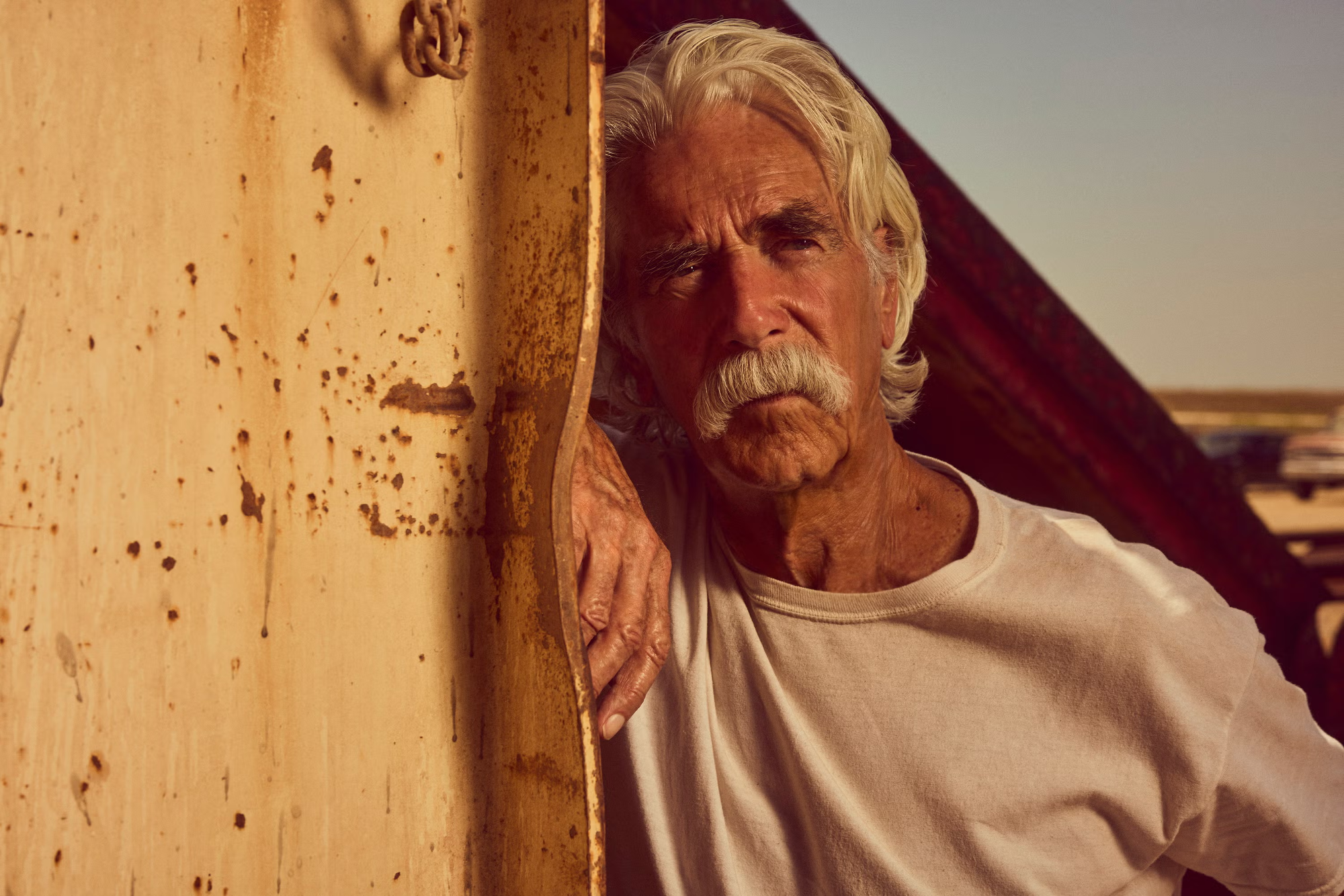
While Tommy's professional life implodes, his personal life unexpectedly improves, thanks to his father's insistence on tagging along for the Fort Worth trip. T.L. (Sam Elliott) asks to join Tommy for work, claiming he's tired of sitting alone at home. Tommy initially refuses—bringing your elderly father to sensitive business negotiations seems like a recipe for disaster—but T.L. persists, and Tommy eventually caves.
What follows is one of the episode's finest threads: a father-son road trip that becomes an impromptu therapy session neither man intended to have. Sam Elliott, as always, is a revelation. He doesn't play T.L. as a doddering old man or a font of homespun wisdom. Instead, he's simply a complicated person carrying decades of regret, trying to connect with a son he failed when it mattered most.
The episode's most visceral moment comes at a bar where someone makes a disparaging comment about Dorothy, Tommy's recently deceased mother. T.L., despite his age and physical limitations, immediately throws a punch, sparking a brief brawl that gets him roughed up but proves his devotion to his late wife's memory. It's a moment that could have played as comedy—old man still has some fight left—but Elliott imbues it with genuine pathos. This is a man defending the only love he ever had, even if that love was toxic and destructive.
The subsequent heart-to-heart between Tommy and T.L. adds essential context to Tommy's character. We see where his stubbornness comes from, his refusal to quit, his determination to fix everything even when it's unfixable. These aren't just personality quirks—they're inherited survival strategies from a man who watched his marriage destroy itself and never figured out how to stop it.
Elliott's presence elevates every scene he's in. His weathered face and gravelly voice carry the weight of lived experience, and when he dispenses wisdom to Tommy, it doesn't feel like screenwriting—it feels like one generation passing hard-earned knowledge to the next.
Love in the Time of Oil
While Tommy's world crumbles and T.L. throws punches, the episode's lighter romantic subplots provide necessary relief. Rebecca (Kayla Wallace) continues her flirtation with Charlie Newsom (Guy Burnet), the field engineer she hooked up with on a plane. Their "business meeting" to discuss the offshore well becomes something decidedly less professional, with chemistry that crackles across the screen.

The show leans into the melodrama here—Rebecca realizing mid-conversation that Charlie is technically her subordinate, the workplace ethics implications, the "should we or shouldn't we" tension that every office romance navigates. Some viewers on Reddit have joked that Landman has "officially crossed over to a Harlequin Romance novella" with these scenes, and they're not entirely wrong. But there's also something refreshing about a Taylor Sheridan show that allows its characters to pursue uncomplicated romantic happiness without everything ending in tragedy.
Cooper, meanwhile, continues his quest to propose to Ariana, this time securing an engagement ring and preparing for the conversation with her father. It's sweet, earnest, and completely divorced from the high-stakes corporate drama consuming Tommy's storyline. That tonal whiplash—from "Will Tommy get fired?" to "Will Cooper get engaged?"—is quintessential Landman, for better or worse.
Angela and Ainsley also get their moment, embarking on a Fort Worth shopping spree at Neiman Marcus that exists purely for the pleasure of watching Ali Larter and Michelle Randolph enjoy themselves. These scenes don't advance the plot. They don't reveal character. They're just... there. And somehow, that's part of the show's strange appeal.
The Rhythm of Nothing Happening
This is where critical opinion on "Dark Night of the Soul" diverges sharply. One camp, represented by reviews praising the episode as peak "comfort TV," appreciates exactly what Sheridan is doing here. These are the scenes of life that matter—the conversations in cars, the family dinners, the small moments of connection that give meaning to all the corporate drama and cartel violence.
As one review eloquently puts it: "Landman is comprised of all the bits that, in other shows, would happen between big moments. It's the long drives and the pointless phone calls and the getting-to-know-you evenings that occur after the deals have been struck." This perspective sees the episode as an artistic choice, a deliberate exploration of what drama can be when you strip away the action beats and focus on human connection.
The opposing camp finds this approach "aggravating" and "repetitive." One critic bluntly stated that Episode 6 was their "least favorite entry of the series so far," calling out the handling of female characters as particularly problematic. "We went from Beth Dutton to Angela, Ainsley, and Cami," they write, questioning why Sheridan's other shows feature "badass" women while Landman struggles with this element.
Both perspectives have merit. The episode does indulge in repetitive character beats—Angela and Ainsley's scenes feel interchangeable with their appearances in previous episodes, serving more as familiar comfort than narrative progression. And the writing for Cami, while giving Demi Moore material to work with, reduces a complex character to someone whose primary function is doubting Tommy without fully articulating why.
Yet there's also something admirable about a show that commits this fully to its unusual pacing. Most television would compress this material into the first ten minutes of an episode and then move on to the "real" story. Landman makes the "in-between" moments the story, trusting that watching Billy Bob Thornton and Sam Elliott talk in a car is inherently worth an hour of your time. And honestly? They're not wrong.
What the Soul Sees in the Dark
The episode's title, "Dark Night of the Soul," references the spiritual crisis described by 16th-century mystic Saint John of the Cross—a period of desolation where one's faith and purpose are tested. For Tommy Norris, that crisis is entirely secular but no less profound.
He's questioning everything: his value to M-Tex, his relationship with Cami, his ability to protect his family, his worth as a leader. The 2008 crash revealed his vulnerability, and now, seventeen years later, that wound has reopened. Cami's willingness to sideline him, Gallino's knowing looks, the sense that he's becoming expendable—all of it points toward an existential reckoning Tommy can't fix with his usual tools.
This is a man who has built his entire identity on being the indispensable fixer. He's the one who solves problems, who negotiates impossible deals, who keeps the machinery running when everyone else panics. But what happens when the person you're trying to fix things for doesn't want your help? What happens when your expertise is dismissed as the perspective of a "loser" who couldn't save his own company?
Tommy doesn't have answers to these questions yet. He's still in the dark night, feeling his way forward, hoping that loyalty and competence will eventually be recognized. But the episode leaves us uncertain whether that hope is justified or delusional.
The Trap Nobody Acknowledges
The most unsettling element of "Dark Night of the Soul" is how clearly we, the audience, can see what Cami cannot. Gallino is not offering M-Tex a lifeline out of generosity or even enlightened self-interest. He's executing a calculated takeover, one that doesn't require force because it relies on something far more effective: erosion of trust.
First, he provides financing M-Tex desperately needs, making himself indispensable. Then, he creates situations where Cami must choose between Tommy's caution and Gallino's solutions, gradually positioning Tommy as an obstacle rather than an asset. Finally, he waits for the "sharks" he mentioned—the board members, the competitors, the opportunists—to do his work for him, convincing Cami that she needs to cut Tommy loose.
It's brilliant, in a sociopathic way. By the time Cami realizes she's been manipulated, Gallino will have so thoroughly integrated himself into M-Tex's operations that removing him will be impossible. And Tommy, the one person who sees what's happening, is powerless to stop it because his warnings just reinforce Cami's perception of him as paranoid and overly cautious—a "loser" afraid to take necessary risks.
The tragedy is that Tommy's not wrong. But being right doesn't matter if nobody believes you.
The Episode That Divides
"Dark Night of the Soul" will likely be remembered as one of Landman's most polarizing episodes. It's either a masterclass in character-driven drama that trusts its audience to appreciate subtlety, or an indulgent hour of television that mistakes atmosphere for substance. Both readings are valid.
What's undeniable is that the episode represents Sheridan leaning fully into what makes Landman different from his other shows. This isn't Yellowstone's operatic family warfare or Mayor of Kingstown's gritty crime drama. It's something quieter, stranger, and harder to categorize—a show about the moments between moments, the conversations that don't lead anywhere except deeper understanding, the professional crises that unfold not with explosions but with handshakes and subtle shifts in power.
Billy Bob Thornton continues to be the show's anchor, playing Tommy with a world-weariness that never tips into self-pity. Even as his character's position crumbles, Thornton maintains Tommy's dignity, his dark humor, his refusal to quit even when quitting might be the smart move. It's a performance that rewards patient viewing, built on small gestures and loaded silences rather than big emotional displays.
Sam Elliott, in limited screen time, steals every scene he's in simply by being present. His T.L. is neither villain nor saint but something more interesting—a flawed man trying to make amends before time runs out, unsure if he even deserves forgiveness but asking for it anyway.
And Demi Moore, while saddled with material that doesn't always serve her character well, brings gravitas to Cami's desperation. You understand why she's making the choices she's making, even if you wish she wouldn't.
Everything and Nothing
As the episode ends with Tommy at the Cattleman's Club, surrounded by celebration he can't fully enjoy, we're left with a question that defines not just this episode but the entire second season: Can Tommy Norris survive in a world where his expertise is seen as paranoia, his caution as cowardice, his experience as evidence of failure?
The dark night of the soul, theologically speaking, is supposed to lead to transformation and renewal. But in Taylor Sheridan's West Texas, that kind of redemption isn't guaranteed. Sometimes the darkness just goes on, and you learn to navigate by feel, hoping you don't trip over something that destroys everything you've built.
"Dark Night of the Soul" is, depending on your perspective, either the episode where nothing happens or the episode where everything that matters happens. It's an hour of television that dares to be boring in service of being real, that values character over plot, that believes watching people talk in cars and at rodeos and over dinner is worth as much as any shootout or corporate coup.
Whether that gamble pays off depends entirely on what you want from your television. But one thing is certain: Nobody else is making shows quite like this. And in an era of algorithmically optimized content designed for maximum engagement, there's something admirable—maybe even radical—about a series that insists on taking its time, trusting its actors, and telling its story at the speed of life rather than the speed of plot.
Tommy's job is on the line. M-Tex's future hangs in the balance. Gallino's trap is closing. And Tommy, as always, will smile through it all and keep driving, because that's what landmen do. They endure. They adapt. And when the dark night finally ends, they're still standing, whether they deserve to be or not.