Boom Towns: How Oil Transforms Small Texas Communities — and What Landman Gets Right
Population surges, $368K median homes, Death Highway fatalities, and the social cost of pumping 5.5 million barrels a day from the Permian Basin
West Texas setting guide
How this topic fits the world of Landman
This article explains one part of the larger West Texas story behind the series. For the full map of setting, filming reality, Midland-Odessa, and the Permian Basin, start with the West Texas in Landman hub.
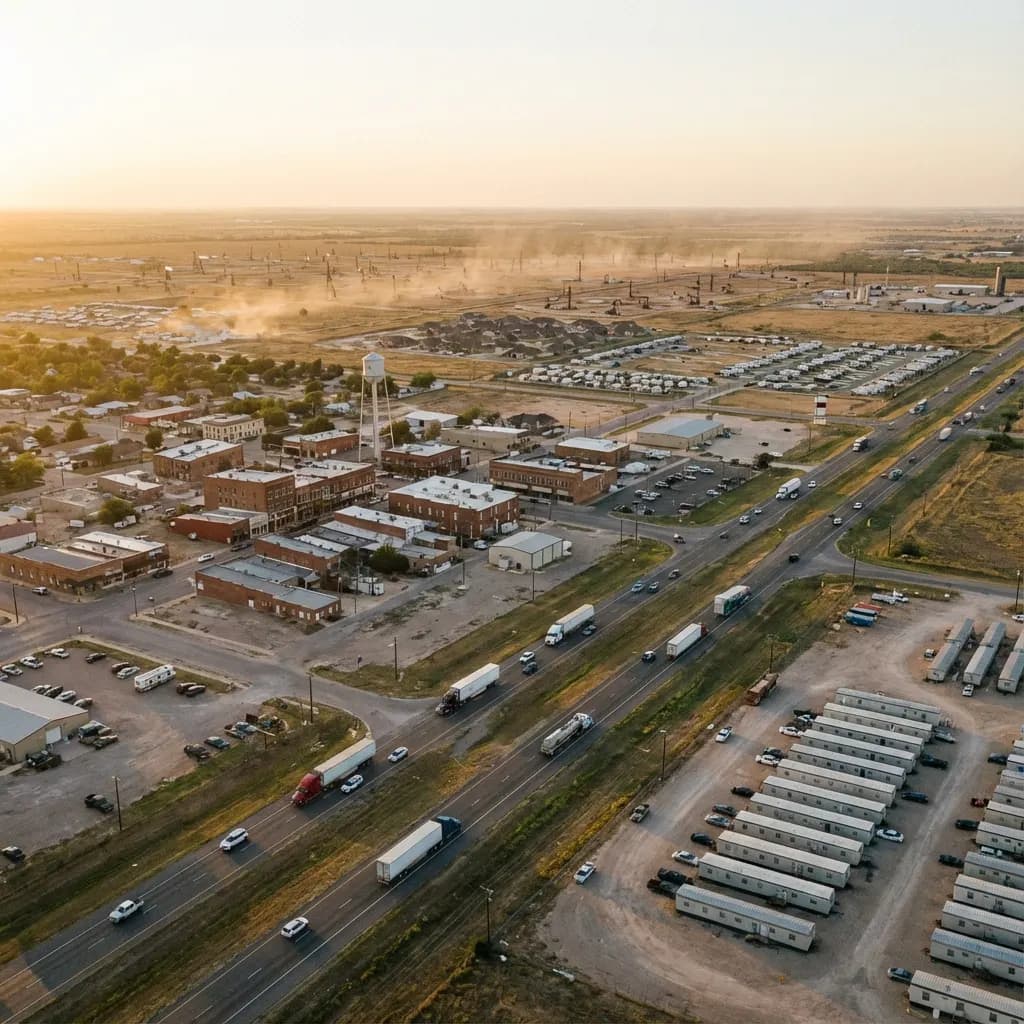
Open the West Texas hubIn Taylor Sheridan's gritty exploration of the Texas oil patch, Landman paints a vivid portrait of a society completely overpowered by industry. We see dust-choked towns, overflowing RV parks ("man camps"), bumper-to-bumper fleets of mud-caked contractor trucks, and an overwhelming, palpable tension fueled by endless rivers of cash. But is this apocalyptic, wild-west depiction purely Hollywood imagination? Not exactly. When a modern oil boom hits, communities like Midland and Odessa transform overnight, and the reality is often stranger — and richer — than fiction.
Behind the fictional M-Tex Oil company and the staggering billion-dollar deals brokered by Tommy Norris lies the true beating heart of American energy independence: the Permian Basin. This is a deep dive into the very real social calculus of an oil boom — where unimaginable prosperity clashes daily with failing infrastructure, where six-figure roughneck salaries coexist with teacher shortages, and where the price of a barrel of crude dictates whether a town thrives or dies.
Midland & Odessa: The Epicenter of the Frenzy
The twin cities of Midland and Odessa serve as the cultural and economic anchor for the 75,000-square-mile Permian Basin. Today, this massive geological bathtub pumps out over 5.5 million barrels of crude oil every single day — making it the second-largest producing oilfield in the world, trailing only Saudi Arabia's Ghawar field. The basin accounts for a staggering 43% of all U.S. crude production.
When hydraulic fracturing (fracking) and horizontal drilling unleashed the shale revolution over the last decade, it triggered a modern-day gold rush. According to U.S. Census data, the population of the Midland metropolitan area surged to an estimated 143,687 by 2024 — an 8.1% increase since 2020. Odessa hit 116,402, up 4.6% in the same period. The broader Odessa-Midland market now exceeds 499,000 residents and is projected to surpass 521,000 by 2030.
But unlike traditional cities that grow organically, a boom town swells violently, pulling in tens of thousands of young, predominantly male workers hunting for six-figure salaries requiring nothing more than a high school diploma and an iron will. The resulting societal pressures are immense — and it is precisely this explosive transformation that Landman captures with uncomfortable accuracy.
📈 The Staggering Financial Footprint (2024)
$119 Billion Economic Impact
The Permian Basin contributed $119 billion to the U.S. economy in 2024, supporting over 862,250 jobs nationwide. It generated $19.2 billion in direct state taxes — including $1.6 billion specifically allocated to school districts. By 2050, the region is projected to produce approximately $350 billion in gross product and support over 1 million jobs. Source: Permian Basin Oil and Gas Magazine
The Housing Crisis: Why Six-Figure Earners Live in RVs
One of the most authentic visual hallmarks of Landman is the presence of "Man Camps" — sprawling, makeshift gravel lots packed end-to-end with RVs, manufactured homes, and temporary dormitories. To outsiders, it looks like extreme poverty. In reality, the men living inside those thin-walled trailers are often pulling down $120,000 to $180,000 a year as field workers and landmen.
When a boom hits, the labor force triples in months, but houses cannot be built that fast. Consequently, the local real estate market breaks. According to Norada Real Estate, Midland's median home sale price hit $368,035 in December 2024 — an 11.5% increase from the previous year, with the median sale price per square foot surging an extraordinary 28.8%. Home sales themselves jumped a staggering 66.7% year-over-year.
The rental market is equally brutal. Midland Reporter-Telegram data shows Midland's median rent is projected to jump from $1,679 to $1,977 in 2025 — a 17.7% year-over-year increase, placing it among the steepest rent hikes in any small U.S. metro area. Odessa isn't far behind, with a projected 13.2% rent increase to $1,754.
🍔 The Fast-Food Economics
The inflation caused by the oil patch trickles down to everything. At the height of the boom, local McDonald's and Walmart locations were forced to offer $18 to $22 an hour plus signing bonuses just to retain cashiers — because anyone capable of passing a drug test could walk out the door and make double that washing drill pipes in the oil field. Restaurants close entirely when they can't compete for labor with rigs paying $30/hour for entry-level work.
Schools Under Siege: 30,000 Students and Counting
The boom's footprint extends deep into the community's most critical institutions. Midland Independent School District (MISD) enrolled 29,602 students in the 2024-2025 academic year, with projections exceeding 30,100 for 2025-2026. When a town's population surges 8% in four years, classrooms overflow. MISD has been forced to redraw boundary lines to redistribute students across facilities, and portable classroom buildings dot school lawns across the district.
The deeper crisis is staffing. Teachers in Midland earn salaries that, while competitive by Texas standards, are dwarfed by what an 18-year-old can make on a drilling rig. The district competes for talent against an industry that doesn't require a college degree but pays twice as much. This creates a vicious cycle: the parents working the rigs need quality childcare and schooling, but the industry siphons away the very workforce required to provide it.
Despite these pressures, there are signs of resilience. MISD received an overall "C" rating (72/100) for the 2024-2025 school year, improving from prior years. The community pours oil tax revenue back into education — $1.6 billion in school taxes from Permian Basin operations in 2024 alone — but the fundamental challenge of building institutional capacity as fast as the wells are drilled remains unsolved.
Healthcare on the Brink: The $157 Million Bet
If the schools are strained, the healthcare system is at the breaking point. Midland Health reported surging patient volumes across obstetrics, surgery, and the emergency room throughout 2024. The hospital system initiated a $157 million facility expansion in February 2024, scheduled for completion in late 2026 — a direct response to the boom's impact on healthcare demand.
But bricks and mortar are only half the battle. The real crisis is people. Texas faces a projected shortfall of nearly 60,000 registered nurses by 2032, according to the Texas Hospital Association. In 2021 alone, over 15,000 qualified applicants were turned away from Texas nursing schools due to capacity limitations. In the Permian Basin, this statewide nursing shortage is compounded by the same labor market distortion affecting every other service industry: why endure the stress and emotional toll of nursing for $65,000 a year when you can drive a water truck for $85,000?
Midland Health has responded by partnering with Midland College, the University of Texas Permian Basin, and Odessa College to cultivate a local pipeline of healthcare workers. They've also launched "Medical Explorers" programs targeting high school students. But as Midland Health's own leadership has stated, recruitment and retention of medical staff is their "top priority for the next five to ten years."
"Death Highway": The Permian Basin's Deadliest Stretch
The show accurately captures the terrifying reality of navigating West Texas roads. The single greatest danger to an oilfield worker isn't a rig blowout — it is the commute. U.S. Highway 285, stretching from Carlsbad, NM, through the heart of the Permian, has infamously earned the moniker "Death Highway."
These rural, two-lane country roads were designed decades ago for slow-moving tractors and local ranching traffic. Today, they are choked with 80,000-pound water haulers, frac sand trucks, and exhausted roughnecks driving multi-ton diesel pickups after grueling 14-hour shifts.
☠️ The 2024 Toll: By The Numbers
25,309 Crashes. 320 Deaths. 915 Serious Injuries.
In 2024, the Permian Basin recorded 25,309 traffic crashes resulting in 320 fatalities and 915 serious injuries. Crashes in the Permian are nearly twice as likely to be fatal compared to the rest of Texas — and approximately half of all fatal incidents involve commercial vehicles. Texas DPS conducted 8,329 inspections in the Midland District alone, placing 4,000 vehicles and 1,419 drivers out of service for 50,931 violations. Sources: Midland Reporter-Telegram, Texas Tribune
The good news: the Permian Road Safety Coalition (PRSC) reported a 13.9% decrease in road fatalities across the Basin in 2025 compared to 2024, with Texas counties dropping from 207 to 179 deaths. The bad news: not all areas improved. Midland County saw fatalities increase from 34 to 45 — a 32% jump — even as neighboring Ector County improved from 51 to 44. The top contributing factors remain speeding, driver inattention, and fatigue from punishing shift schedules.
Crime, Cartels, and the TV Drama Overlay
In Landman, the oil industry frequently intersects with the violent underworld of Mexican cartels — hijacked oil trucks, brutal intimidation tactics, and localized warfare. Is this real?
According to local law enforcement, it is largely dramatized for television. While oil theft (colloquially known as "fluid theft") does occur — sophisticated rings steal raw crude or produced water from remote well sites — the overt, militarized cartel skirmishes depicted by Taylor Sheridan are cinematic adrenaline. Curiously, despite the explosive population growth and the influx of transient young men flush with cash, violent crime rates in Midland have historically remained relatively low or even trended downward during boom peaks, as everyone is simply too exhausted from 100-hour workweeks to cause trouble.
✅ What Landman Gets Right About Boom Towns
- Man camp culture: The cramped RV parks, alcohol-fueled boredom, and transient workforce are authentic
- Housing inflation: Six-figure earners in trailers while homes cost $370K+ is real
- Service worker displacement: Fast-food staff quitting for rig jobs is documented
- Road danger: The terrifying truck traffic and highway fatalities are understated, if anything
- Boom-bust psychology: The collective anxiety about oil prices is absolutely real
🎬 Hollywood Elements
- Cartel violence: Organized cartel operations targeting oil infrastructure are heavily dramatized
- Speed of transformation: Towns change over years, not overnight as compressed for TV
- Uniform chaos: Real boom towns have organized corporate camps alongside the wild RV lots
The Water Problem Nobody Talks About
While oil commands the headlines, the true operational bottleneck in the modern Permian Basin is water. A single fracked well requires up to 20 million gallons of water, mixed with sand and proprietary chemicals, to shatter the shale rock at depths exceeding 10,000 feet. In a semi-arid desert where ranching communities already fight over every acre-foot, this creates an existential tension.
Furthermore, the process produces "produced water" — briny, toxic fluid that must be safely disposed of in deep injection wells. Managing this wastewater is as fiercely contested as transporting the crude itself. The environmental friction between landowners, regulatory agencies, and oil titans forms the invisible war occurring beneath every handshake. This water dynamic is one area Landman has yet to fully explore — and it's arguably the Permian Basin's most explosive unresolved conflict.
The Boom-and-Bust Psyche: Living on a Knife's Edge
Ask any long-time Midland resident, and they'll tell you the same thing: "This isn't our first rodeo." The Permian Basin has experienced devastating busts — 1986, 1998, 2014-2016, and the COVID crash of 2020 — each one emptying the man camps, cratering home values, and leaving behind foreclosed dealerships full of lifted trucks nobody can afford. As WTI crude prices fluctuate, so does the entire ecosystem.
A sustained drop below $50 a barrel means the man camps empty out, the luxury trucks are repossessed, and the manic energy evaporates overnight. Landman captures this collective psychological anxiety perfectly: it's a culture that works furiously to extract the earth's wealth today, because absolutely no one knows what tomorrow's barrel price will bring.
What separates the current boom from its predecessors is the sheer scale of capital involved. With private equity firms and integrated majors now controlling vast portions of the basin, the traditional wildcatter boom-bust volatility is being replaced by a more calculated, disciplined extraction regime. But for the workers on the ground — the roughnecks, drivers, welders, and service workers whose livelihoods depend on rig count — the anxiety remains unchanged.
The Verdict: 8.5/10 Realism Score
Landman's portrayal of boom town dynamics earns a high realism score. The housing crisis, labor market distortion, road danger, and boom-bust psychology are all depicted with uncomfortable accuracy. The cartel overlay and compressed timeline are the primary dramatic concessions. For anyone who has driven through Midland at 5 AM and been surrounded by a convoy of water trucks, the show feels less like fiction and more like a documentary with better lighting.
Frequently Asked Questions About Permian Basin Boom Towns
How expensive is housing in Midland, Texas, during an oil boom?
As of December 2024, the median home sale price in Midland was $368,035, up 11.5% year-over-year. Median rent is projected to hit $1,977/month in 2025 — a 17.7% increase. During peak booms, studio apartments that normally rent for $800 can exceed $2,500. The disconnect between blue-collar wages in service industries and housing costs often forces non-oil workers out of the community entirely.
Are "Man Camps" really as chaotic as shown in Landman?
Real man camps range from highly organized, corporate-run facilities resembling strict military barracks (with curfews, cafeterias, and complete alcohol bans) to unregulated, chaotic clusters of private RVs parked on random gravel lots with inadequate sewage systems. The show leans heavily into the latter for dramatic effect. In reality, major operators like Civeo and Target Logistics run sophisticated workforce housing with gym facilities, hot meals, and laundry services — far from the stereotypical image.
Why is Highway 285 called the "Death Highway"?
U.S. Highway 285 earned its grim nickname due to the disproportionate number of fatal crashes involving heavy commercial vehicles. In 2024, the Permian Basin recorded 25,309 crashes, 320 fatalities, and 915 serious injuries. Crashes in the region are nearly twice as likely to be fatal compared to the rest of Texas, with approximately half involving commercial vehicles. Contributing factors include driver fatigue from 12-14 hour shifts, distracted driving, and rural roads never designed for the current volume of 80,000-pound trucks.
Do roughnecks really blow all their money during a boom?
The stereotype of the young roughneck buying an $80,000 lifted Ford F-250 and blowing his paycheck on Friday night is a well-documented cultural phenomenon. Midland's auto dealerships report their best sales months during boom peaks. However, many seasoned oilfield veterans use the boom strategically — aggressively paying off mortgages, investing in land, maxing out 401(k) contributions, and securing early retirements before the inevitable bust arrives.
How does an oil boom affect schools and hospitals in the Permian Basin?
Midland ISD enrolled nearly 30,000 students in 2024-2025 and projects exceeding 30,100 by 2025-2026. Schools have been forced to redraw boundary lines and deploy portable classrooms. Healthcare is even more strained: Midland Health is investing $157 million in facility expansion, but Texas faces a projected shortfall of 60,000 nurses by 2032. The fundamental problem is that oil salaries drain talent from every other sector — creating the paradox of a wealthy community that can't staff its own schools and hospitals.
Is cartel activity in the Permian Basin as intense as Landman shows?
No. While oil theft ("fluid theft") does occur — criminal rings siphon crude or produced water from remote well sites — the militarized cartel warfare depicted in the show is heavily dramatized. Local law enforcement reports that violent crime in Midland has actually trended downward during boom peaks. The show uses cartel activity as a dramatic device to heighten tension, but the real threats to oil workers are far more mundane: highway accidents, equipment failures, and toxic gas exposure.
Sources
- Midland Census Data Shows 8.1% Population Growth - Midland Reporter-Telegram
- Midland Housing Market 2024: Median Price $368,035 - Norada Real Estate
- Midland Rent Projected to Jump 17.7% in 2025 - Midland Reporter-Telegram
- MISD Enrollment Exceeds 29,600 for 2024-2025 - Midland Reporter-Telegram
- MISD Accountability Rating 2024-2025 - Midland ISD
- Midland Health $157M Expansion, Staffing Priorities - Midland Reporter-Telegram
- Texas Nursing Shortage: 60,000 Projected Shortfall by 2032 - Texas Hospital Association
- Healthcare Workforce Pipeline Initiative - Midland College
- Permian Basin $119 Billion Economic Impact in 2024 - PB Oil & Gas Magazine
- Permian Basin 2024 Traffic Data: 25,309 Crashes, 320 Deaths - Midland Reporter-Telegram
- Energy Region Crash Fatalities and Commercial Vehicle Data - Texas Tribune
- 2025 Permian Basin Road Fatality Decrease of 13.9% - Permian Road Safety Coalition
- Permian Basin Employment 2.5% Growth, Housing Trends - Federal Reserve Bank of Dallas
- Permian Basin Housing Shortage and Construction Challenges - Texas Standard
- Permian Basin Highway 285 Fatality Analysis - Zehl & Associates
- U.S. Census Bureau Population Estimates 2024 - U.S. Census Bureau
Related Blog Reading
More Landman analysis on this topic

Texas Oil Boom Towns: The Rise and Fall of West Texas Oil Communities
Opening: Through the Lens of Landman The opening shots of Landman tell you everything you need to know about West Texas: an endless expanse of flat, scrubby desert stretching to the horizon, interrupted only by the rhythmic bobbing of countless pump jacks—mechanical horses drinking crude from deep beneath the earth. Dust devils swirl across two-lane highways where 18-wheelers loaded with drilling equipment roar past at dangerous speeds. Through the heat shimmer, you can see the orange glow of g

Is Landman Based on a True Story? The Boomtown Podcast and Real West Texas Oil Boom Explained
Landman is fictional, but it is rooted in the Boomtown podcast and the real Permian Basin oil boom. Here is what comes from reality, what is dramatized, and why the show feels so specific.

When the Oil Tycoon Plays Himself: Jerry Jones' Million-Dollar Moment in 'Landman'
It was only fitting that Jerry Jones, who made a fortune in the oil industry, made an appearance on a popular TV series about the oil boom in West Texas. And no surprise that the Dallas Cowboys owner and president earned rave reviews. When Jones appeared in the ninth episode of Paramount+'s Landman, it wasn't just another celebrity cameo—it was a moment where art, commerce, and authenticity collided in the most Texas way possible. In a show that explores the brutal realities and human costs of
Roughneck Life: What It's Really Like Working in West Texas Oil Fields
In the vast, sun-scorched expanse of West Texas, under a sky that stretches into an infinite blue, a modern-day archetype toils for the black gold that fuels the world. He is the roughneck, a figure as central to the mythology of Texas as the cowboy, yet often shrouded in a layer of crude oil and misunderstanding. As Taylor Sheridan’s series Landman drills into the high-stakes world of the Permian Basin, it brings this figure to the forefront—the man on the rig floor, the engine of the boom. To
Related Episodes
See how this oil-industry topic shows up in the series.